
 Awards
Search
Awards
Search
Captain
Lester T. Snow
Army
Inducted 2008
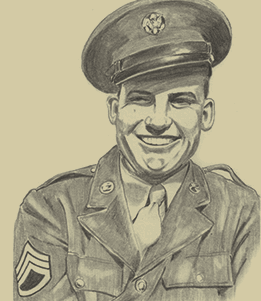
Captain Lester T. Snow was born in Seiling, Oklahoma, 17 July 1920; moved to Tonkawa, Oklahoma in 1923; graduated from Tonkawa High School in 1939; died in Oklahoma City, Oklahoma 4 November 1973; and now rests in the Tonkawa IOOF Cemetery in Tonkawa, Oklahoma.
In 1938, he enlisted into the Oklahoma National Guard, while a senior at Tonkawa High School, and was attached to the Headquarters Battery, 189th Field Artillery Battalion, at Tonkawa, Oklahoma. He was appointed as a Corporal on 1 June 1940; then to Staff Sergeant on 1 June 1942. He served in World War II in the 45th Infantry Division in the European Theater of Operations.
On 12 May 1944, he was awarded the Silver Star Medal for exceptional actions taken on 13 September 1943 at Salerno, where his heroic actions saved the lives of his commanding officer, the executive officer, their driver, and radioman, and he “manned a .50-cal. machine gun in an open position when an enemy counterattack threatened his howitzer position, and though under enemy small arms and mortar fire, he placed extremely effective fire on the attacking enemy, inflicted heavy casualties, silenced the fire of two machine guns and a mortar, and destroyed two enemy vehicles.”
In 1943, from salvage on the battlefield, he created a .50 caliber machine gun mount capable of firing two guns in 360 degrees, from a ground position or from a truck. He was recognized for his invention, called “Combination Mount for Dual .50s” in an article in the February 1945 Field Artillery Journal.
He received a battlefield commission to Second Lieutenant, effective 13 April 1944 and was awarded the Bronze Star Medal. He was promoted to First Lieutenant on 12 December 1944.
He was commended by commanding officers for his dedication and service, as he served variously as a forward observer, a leader of an antitank section, and the NCO in charge of a mine detection platoon before receiving a battlefield commission.
Upon completion of service in World War II, he returned to Tonkawa, Oklahoma, where he received a commendation from Lieutenant Colonel O.T. Autry, 189th FA Bn, OKNG, commanding, on 29 December 1947; he was appointed commanding officer for Service Battery, 189th Field Artillery Battalion, Tonkawa, Oklahoma on 21 January 1948. On 12 April 1948, he was promoted to the rank of Captain. He served in the Oklahoma National Guard and was called up for service in the Korean Police Action. Severe ill health caused him to be returned to Oklahoma without having served in the Korean Conflict. He was honorably discharged on 9 April 1952.