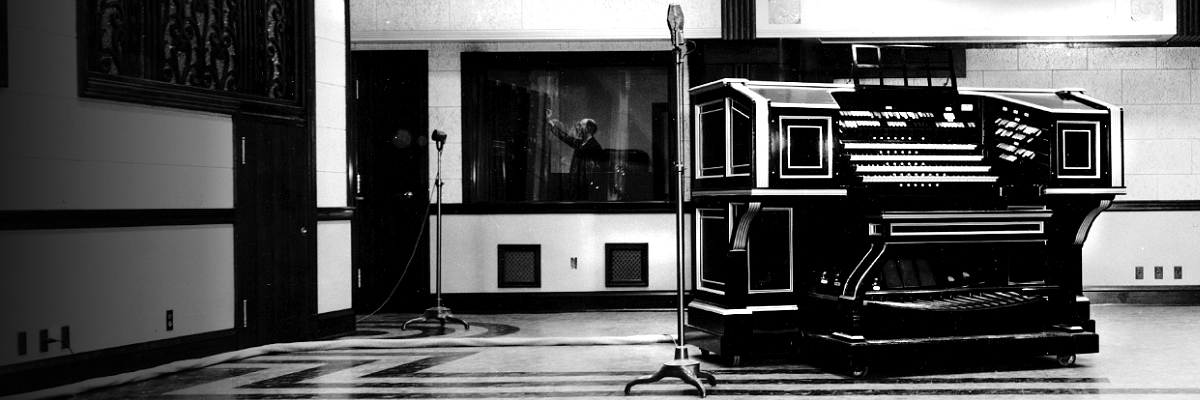
The Kilgen Theatre Organ
Upcoming Performances
Kilgen Theatre Organ performance featuring the silent film My Best Girl (1927) with Clark Wilson
About the Kilgen Theatre Organ
The historic 1935 Kilgen Theatre Organ is a pipe organ designed to mimic a full orchestra with dramatic musical tones and special effects. This restored artifact of Oklahoma’s golden era of radio is a connection to our musical history.
Saved From Silence (2023) includes a short history of the Kilgen Theatre Organ and shares how a valuable piece of Oklahoma history was spared from extinction.
Theatre Organs
The Kilgen Theatre Organ differs from other organs in a number of ways. While they come from the same roots, the theatre organ is quite different from a church or classical organ. Instead of hymns, a theatre organ was used to accompany silent movies with effects for comedy and drama. Theatre organs are generally louder and their pipes sound like musical instruments, such as trumpets and saxophones, with special effects like drums, bells, and whistles. Despite the introduction of motion pictures with sound in the late 1920s, theatre organs enjoyed great popularity in the 1930s.
WKY and the Municipal Auditorium
This particular organ was manufactured by the George Kilgen and Sons Company of Saint Louis in 1935. The Kilgen Opus 5281, a four manual, 14 rank theatre-style pipe organ, was installed in the new studios of WKY radio—then located in the Skirvin Tower building—just before the station went on the air in 1936. Just a week later, WKY presented Ken Wright on the Kilgen for one hour every night at 10:45 p.m. On Wright’s second night he played favorites of the time such as “Open My Blue Eyes,” “Across the Breakfast Table,” “Valse Bluette,” and “Dinner at Eight.”
With the introduction of television in the late 1940s, interest in live music on the radio faded and it became more and more difficult to support an expensive studio instrument like the Kilgen Theatre Organ. When WKY moved their studios to a new building in March of 1951 the organ did not make the move. WKY sold the organ to the City of Oklahoma City and it was installed in the Municipal Auditorium in downtown Oklahoma City. It was used for a variety of programs and concerts. In 1998 the Municipal Auditorium (now the Civic Center Music Hall) was to be remodeled a second time and plans did not include the Kilgen Theatre Organ. A group of local businessmen led by Greg Robertson began to look for a home for the historic instrument. At his urging, the city council agreed to have the instrument removed and stored until a suitable venue could be found. On August 7, 1998, Robertson invited the mayor, members of city council, some city staff, and a few others to hear beloved local artist Wally Brown play one last private concert. His selections included show tunes and patriotic favorites.
A Home at the Oklahoma History Center
Construction was underway on the Oklahoma History Center when Greg Robertson approached Dr. Bob Blackburn, executive director of the Oklahoma Historical Society, who agreed that such a significant piece of Oklahoma and musical history should be housed in the new center. At Dr. Blackburn’s request, the city agreed to donate the organ. In the Oklahoma History Center, two spaces adjoining the atrium were set aside for the pipe chambers. During this same time President David Boren of the University of Oklahoma (OU) initiated plans for an organ institute at the university. His vision included an organ shop where students would learn to maintain organs as well as play the instruments. In 2015 everything came together to complete the work on the Kilgen Theatre Organ. Additional money was raised from local businesses and foundations. The American Organ Institute (AOI) at the University of Oklahoma was up and running under the direction of Dr John Schwandt. An agreement was reached and the entire organ was taken to Norman to begin an extensive rebuilding.
The Reconstruction
The first phase of the project was the rebuilding of the ornate console. According to Dr. John Schwandt, director of the AOI, this phase included the complete dismantling and renewal of the console cabinet, as well as, all the playing hardware, such as keyboards, stop keys, pedals, and other controls. The second phase required removing all of the pipes, traps, and percussions as well as the windchests (upon which the pipes stand), and other components related to the organ's wind system. The organ was set up and tested in the AOI’s facility in Norman before installation at the Oklahoma History Center.

A close-up of the xylophone.
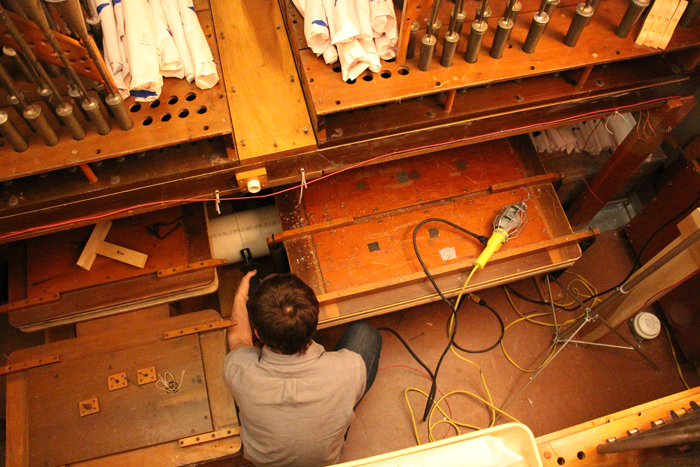
Nathan Rau uses a reciprocating saw to cut through more PVC piping from another offset chest.
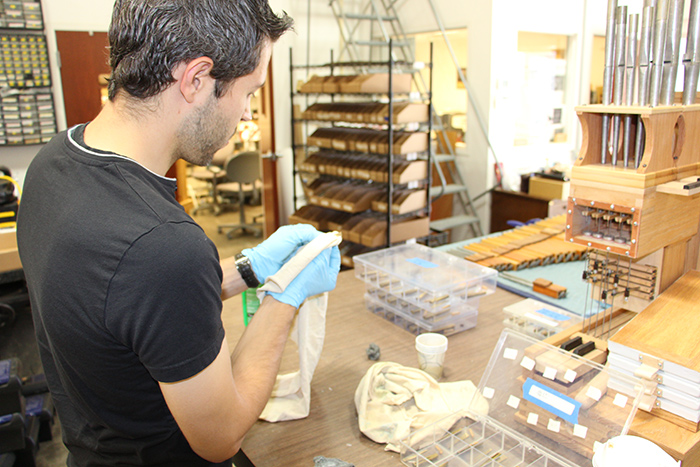
Dr. Adam Pajan cleans reeds and shallots to prepare them for voicing.
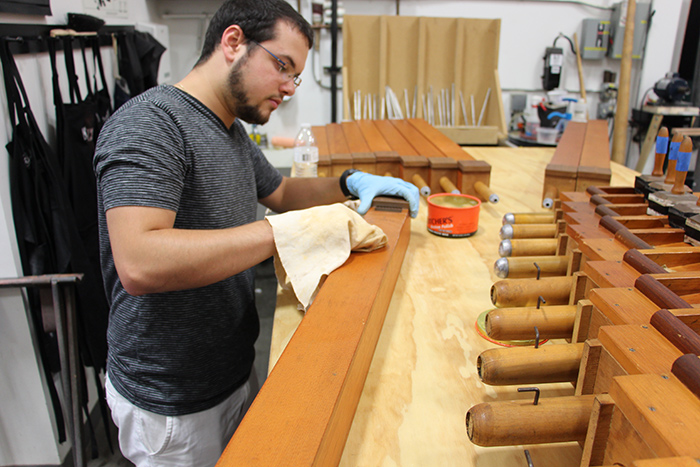
Jesse Oddis, an organ technology master's student, cleans and polishes a stopped flute.
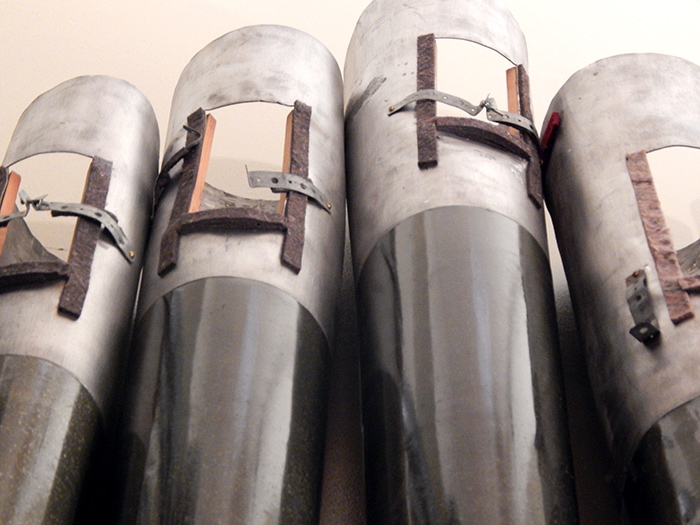
A photo of several metal pipes before AOI repairs. The pipes were seriously damaged by the metal brackets screwed into them and the felt glued to the pipe.
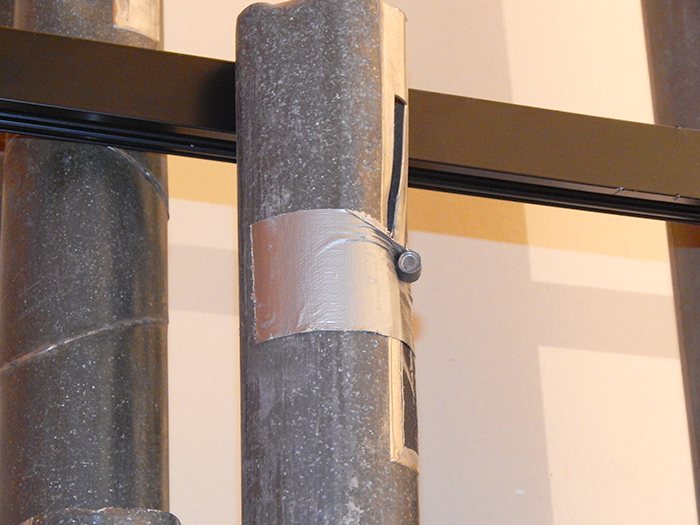
The tuning scroll, complete with duct tape, prior to repair at the AOI.

The tuning scroll of a reed pipe that has nearly broken off from fatigue. This was replaced with a new tuner.
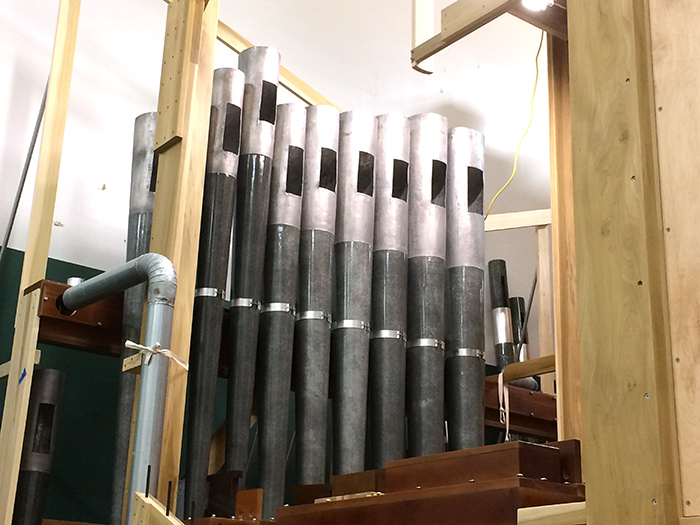
Another view of the 16-foot tuba in the main.

A view of several string pipes.
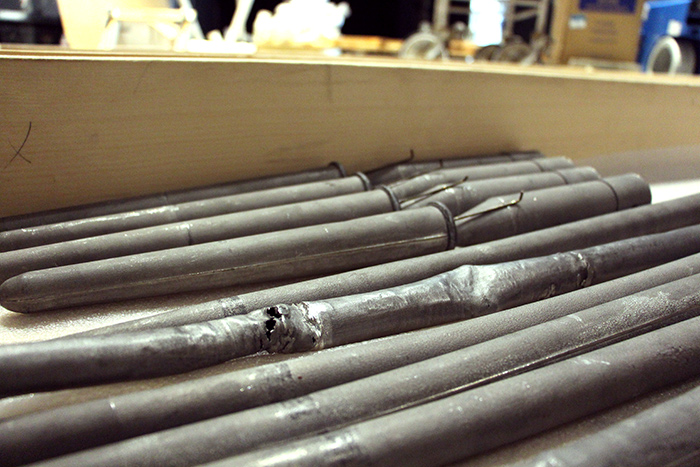
The boots of several reed pipes that were damaged by poor care and the ravages of time. The one with the hole has been replaced.

Another photo of the mallets for the chrysoglott. The mallet heads had dents and dings and the felt is worn away.
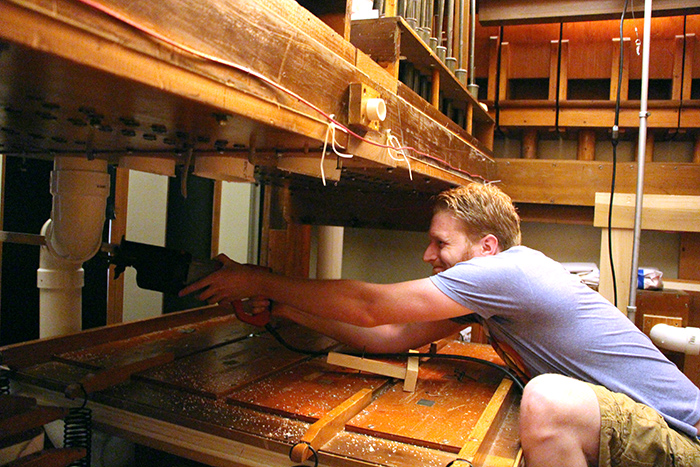
Cameron Couch uses a reciprocating saw to remove PVC piping from the offset chest.
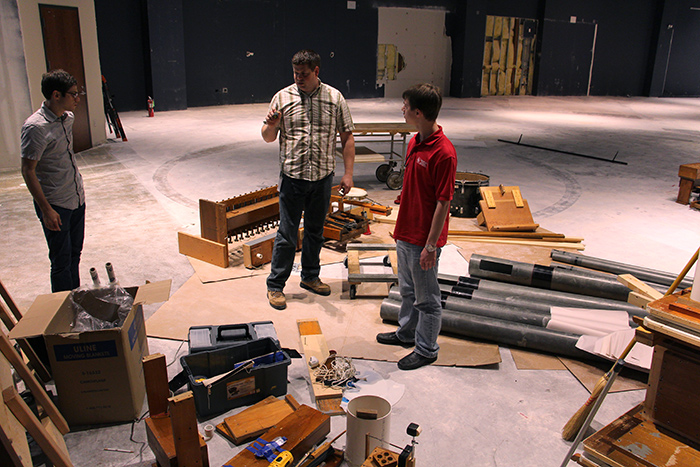
Dan Sliger, Nathan Rau, and Justin LaVoie plan for the final steps of packing the Kilgen.
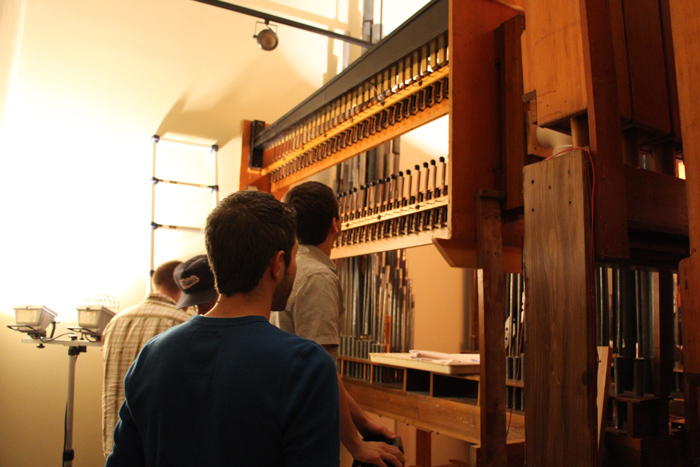
Several AOI students and staff examine the chrysoglott and xylophone before removing it for rebuilding.
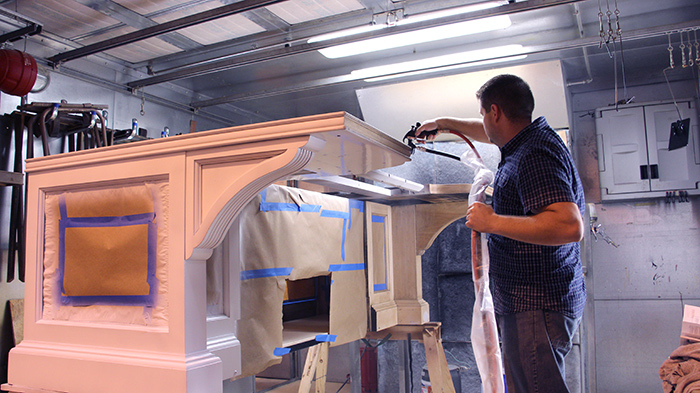
Dan Sliger coats the Kilgen console with white primer in the AOI spray booth.

A photo from the inside of the spray booth showing the freshly lacquered console and the sprayer.
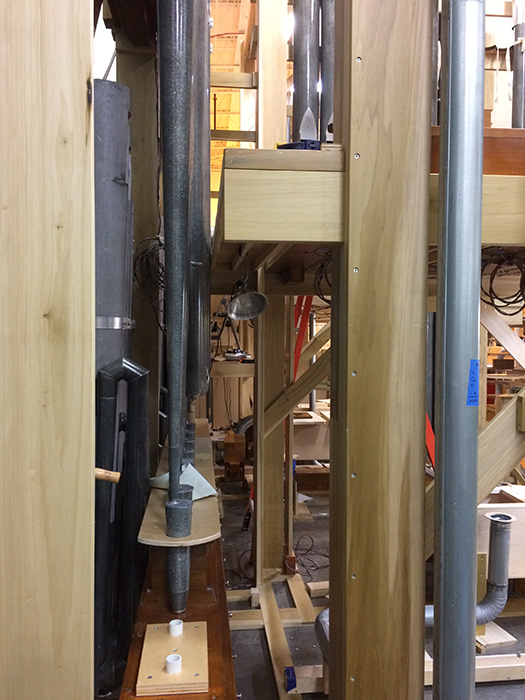
Main chamber set up showing the 16-foot tuba and diaphone pipes.
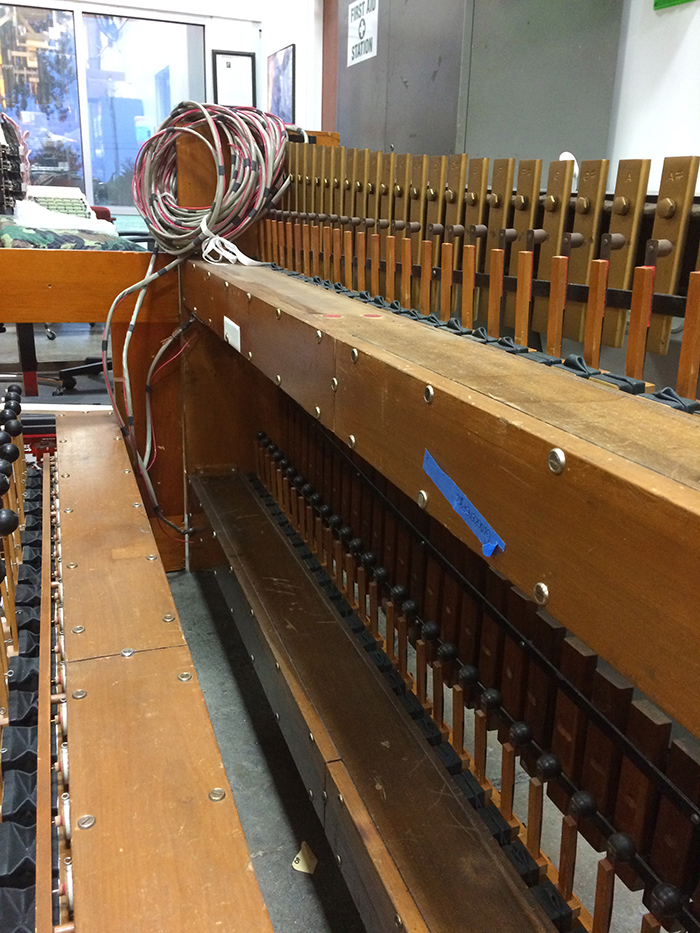
The rebuilt xylophone and glockenspiel await installation.

Reservoir work underway in the AOI Shop. There are 14 reservoirs.