The Daughter of Dawn
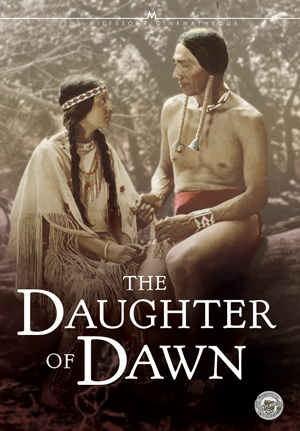
After screening only a handful of times when it was made in 1920, The Daughter of Dawn disappeared without a trace. For almost 90 years it was considered lost—until it was rediscovered by the Oklahoma Historical Society. Now beautifully restored and with a new orchestral score, the film is an astonishing revelation.
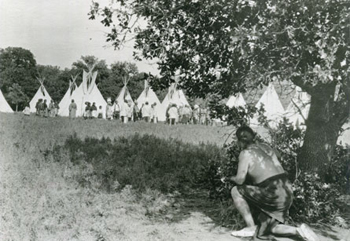
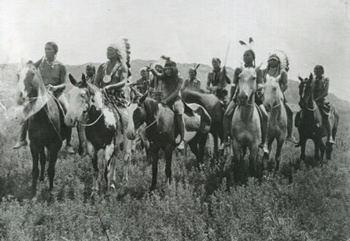
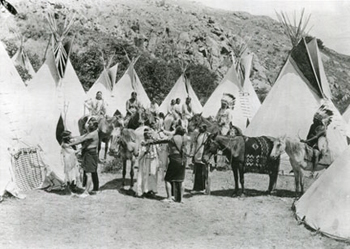
The beautifully filmed drama features romantic rivalry, bison hunts, village scenes, dances, deceit, tests of courage, and hand-to-hand combat. The cast of more than 300 Kiowa and Comanche actors brought their own tipis, horses, clothing, and traditions to the set, making The Daughter of Dawn fascinating to film fans and students of American Indian history and culture.
Bonus features include eight segments produced by the Oklahoma Historical Society about the history and rediscovery of the film.
About the Film
The Daughter of Dawn is an 80-minute, six-reel silent film shot in May, June, and July of 1920 in the Wichita Mountains of southwest Oklahoma.
The film includes a significant tipi given by Cheyenne Chief Nikko-se-vast to the Kiowa Chief Dohausen. The tipi in the movie was renewed in 1916 with images painted by Haungooah (or Silverhorn) and Stephen Mopope, one of the Kiowa Five. That very tipi was given to the Oklahoma Historical Society in 1928.
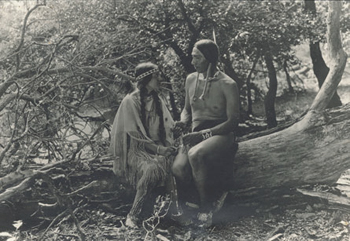
The story, played by an all–Native American cast of 300 Kiowas and Comanches, includes a four-way love story, two bison hunt scenes, a battle scene, village scenes, dances, deceit, courage, hand-to-hand combat, love scenes, and a happy ending. The Native Americans, who had been on the reservation less than 50 years, brought with them their own tipis, horses, clothing, and material culture. The lead actor is White Parker, the son of the great Comanche leader Quanah Parker.
The film features music composed and performed for the showing. The original music composition is by David Yeagley. The score is performed by the Oklahoma City University(OCU) Orchestra: Ben Nilles, conductor; John Cross, music editor; Mark Parker, dean of the School of Music; and Robert Henry, OCU president.
The Story
In the film, the Daughter of Dawn is played by Esther LeBarre. Her character is the daughter of the Chief of the Kiowas, played by Hunting Horse. The two young men who are romantically interested in her are White Eagle, played by White Parker, and Black Wolf, played by Jack Sankadota. Dawn loves White, but the Chief says that Wolf has many ponies so he must consider both as potential husbands for his daughter. So, Wolf loves Dawn. Dawn loves White. White loves Dawn. And for good measure a fourth person is added to this love triangle. Red Wing, played by Wanada Parker, is in love with Wolf. Both White Parker and Wanada Parker were children of the Comanche Chief Quanah Parker.
The script was developed by Norbert Myles, an actor, writer, and director brought into the project by Richard Banks, who started the Texas Film Company in 1916. Myles wrote on the cover of his script, “This story has been made possible by R. E. Banks, whose knowledge of the Indian, and of his traditions, was gained during the twenty-five years that he lived with them.”
On December 18, 2013, the Library of Congress in Washington, DC, selected The Daughter of Dawn as one of the films inducted to its 2013 National Film Registry, a collection of cinematic treasures that represent important cultural, artistic and historic achievements in filmmaking.
Learn More
Read more about this historic film in The Chronicles of Oklahoma.
“The Daughter of Dawn: An Original Silent Film with an Oklahoma Indian Cast,” by Leo Kelley
“The Daughter of Dawn and the Promotion of American Indian Culture,” by Wendi M. Bevitt
Funding for this project provided by
Lawton Community FoundationMcMahon Foundation
National Film Preservation Foundation
Oklahoma City University
Oklahoma Historical Society
Special thanks to the Friends of the Oklahoma Historical Society Archives and the Friends of the Oklahoma History Center.