Removal of Restriction for the Five Tribes
Including Dawes Townsite Records
About This Database
This database includes names indexed from two record groups: general applications and orders for removal of restriction, and petitions for removal specifically for townsite use.
Removal of Restriction Applications and Orders
This index was created from applications made by individuals to remove restrictions from their allotted lands. The American Indian Archives Collection also include orders for restriction to be removed. Documents include the name, roll number (in most cases), tribal affiliation, and, in a few instances, blood quantum. The index includes more than 11,000 names. These materials are part of the Union Agency Records and they pertain to the Five Tribes: Cherokee, Chickasaw, Choctaw (including Mississippi Choctaw), Muscogee (Creek), and Seminole.
Most of the information contained in the document has been included in this database. Below are examples of the application and order documents.
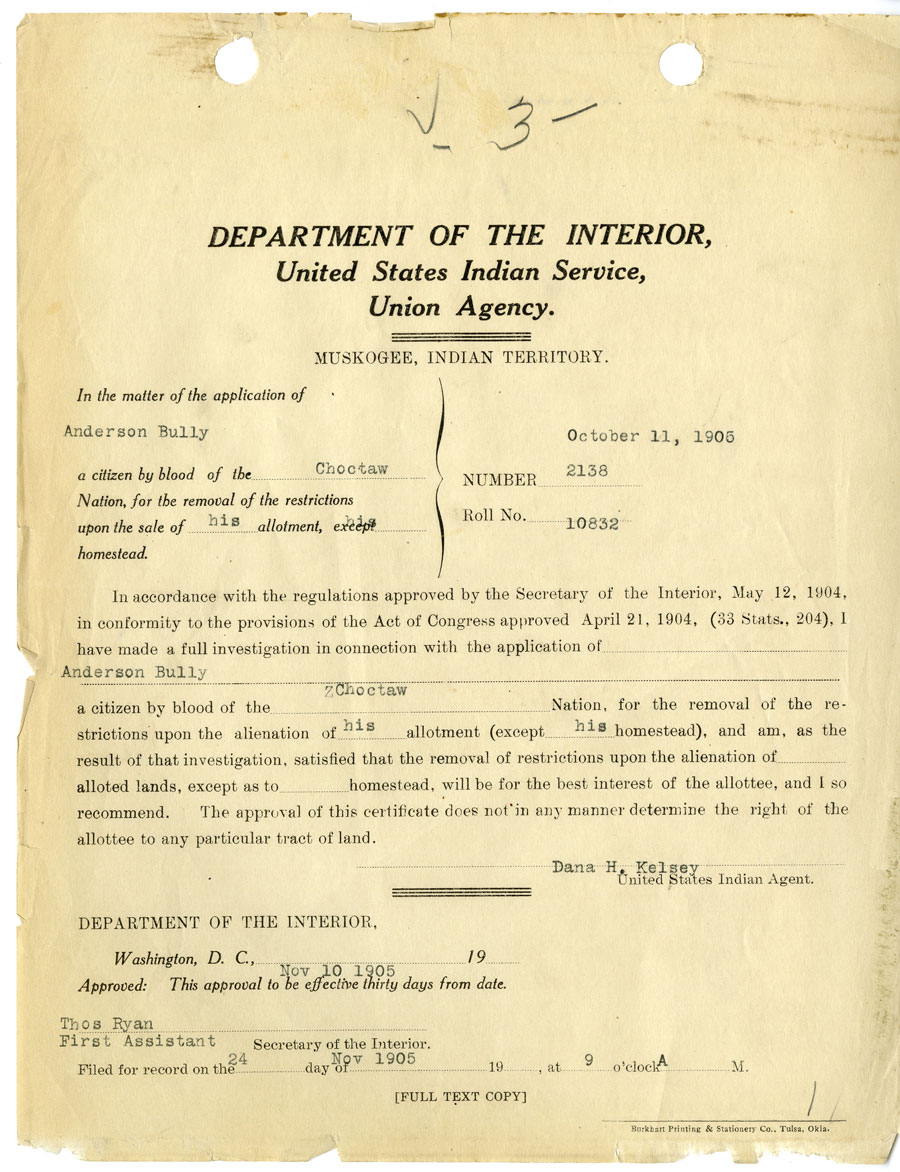
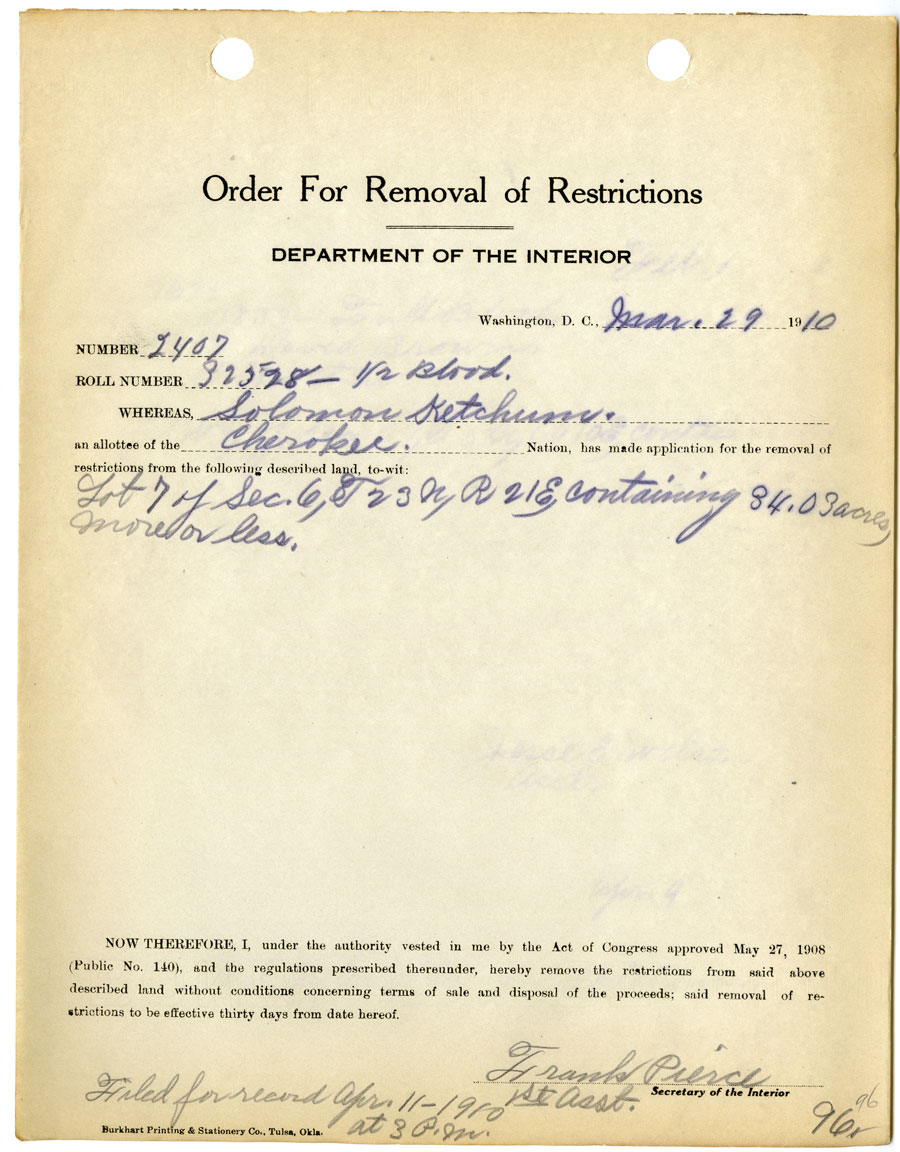
Removal of Restriction for Townsite Use
The townsite records contain petitions from individuals for the removal of restriction on land for townsite purposes. Included in the files are questionnaires, plat maps, and correspondence. Most files include legal land descriptions. To search these records, enter the name of an individual. The files are organized by town within the tribal nations. There are only a few files per town and not all towns are represented. The files date from 1903 to 1909 and can be found in the American Indian Archives, Dawes Commission Records. This database includes 467 names of individuals in Cherokee, Chickasaw, Choctaw, and Muscogee (Creek) Nations.
Why Were Allotments Restricted?
During the land allotment period in Indian Territory, Congress made the decision to restrict allotments of American Indians who enrolled with one-half or more blood quantum. Members of Congress believed that the restricted tribal members did not fully understand what it meant to own land as a private owner, since their cultural practice prior to allotment was to share land communally. Congress also believed these tribal members could become persuaded by white citizens to alienate (or give up) their property, which meant the tribal member might lose their allotment in its entirety.
According to Section 19 of the Act of April 26, 1906, the decision made by Congress states: “That no full blood Indian…shall have power to alienate, sell, dispose of, or encumber in any manner any of the lands allotted to him for a period of 25 years…” This meant that restricted tribal members were fully in control of their own property. The court assigned them a guardian, who would make decisions about the allotment.
On May 27, 1908, the Restrictions Bill was passed, removing restrictions on all lands and homesteads of intermarried whites, Freedmen, and those enrolled with less than one-half blood quantum. For individuals with a blood quantum between one-half and three-quarters, restrictions remained on homesteads, but were removed from all other lands. For those with more than three-quarters blood quantum, all lands and homesteads remained under restriction.
The Restrictions Bill also confirmed the authority of the secretary of the Interior to remove restrictions. Restricted tribal members could make an application to a US Indian agent for the removal of their restrictions. The field agent would then investigate the applicants and forward any reports and recommendations to the Department of the Interior, where they would be reviewed by the secretary of the Interior. The secretary had the final say as to whether restrictions should be removed. Once restrictions were removed, they could not be reimposed.
Section 9 of the Act of April 10, 1926, explains in the instance an allotment recipient died, the restriction would essentially “die” with the original allottee, allowing heirs to gain control of the allotted land.
Access These Records
Visit the Research Center to view these records from the American Indian Archives Collection. Removal of restriction applications and orders are part of the Union Agency records; townsite documents are part of the Dawes Commission records.
Order Copies
The Research Center offers a $15 express service for orders from this database. Please note that this database includes most of the information listed on the records. To order copies of a listing by mail, use the printable order form (PDF) and include the information provided in the index. To order by phone, please call 405-522-5225.