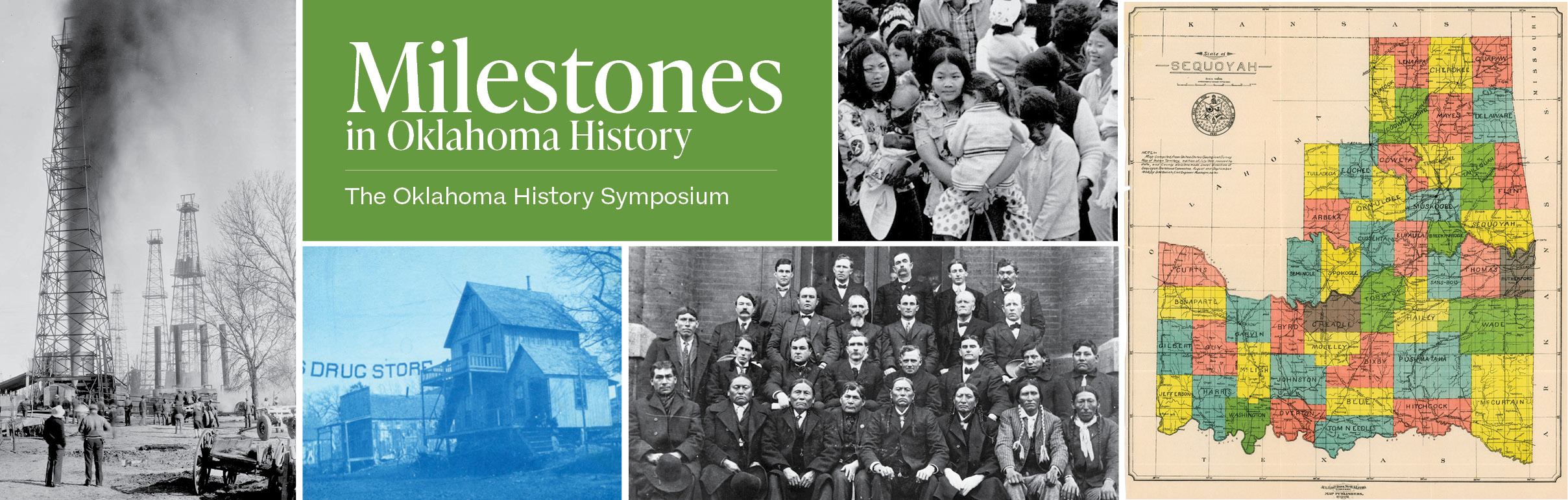
Milestones in Oklahoma History
The Oklahoma History Symposium
Watch sessions on our Oklahoma History Symposium YouTube playlist
The 2026 Oklahoma History Symposium was held on Saturday, May 2, at the Oklahoma History Center in Oklahoma City. Presented by the Oklahoma Historical Society, the symposium is a one-day event encompassing a range of historical topics pertaining to Oklahoma. It provides a venue for scholars, students, educators, public history professionals, and the interested public from across the state and region to share their work and interests with others.
Any views, findings, conclusions, or recommendations expressed during the program do not necessarily represent those of the Oklahoma Historical Society.
Thank You to Our Sponsors

National Rural Utilities Cooperative Finance Corporation
Schedule
| Time | Event |
|---|---|
| 9:30 a.m– 4 p.m. |
Visit symposium exhibitors |
| 9:30 a.m. | Enjoy networking, coffee, and donuts (Devon Great Hall) Oh Sugar Honey Iced Tea food truck will be on-site with iced coffee, tea, lemonade, pastries, and desserts. |
| 10 a.m. | Meeting of the OHS Membership This meeting includes the executive director’s report with updates about OHS activities, the announcement of board election results, the swearing-in of new board members, and possible action on items brought before the membership, if any. This meeting is open to the public. (Chesapeake Event Center) |
| 10:15 a.m. | Organizational Meeting of the OHS Board of Directors In this brief meeting, the OHS Board of Directors elects officers, and the president may appoint committee members. This meeting is open to the public. (Chesapeake Event Center) |
| 10:30– 11:30 a.m. | Book Signing (Devon Great Hall) 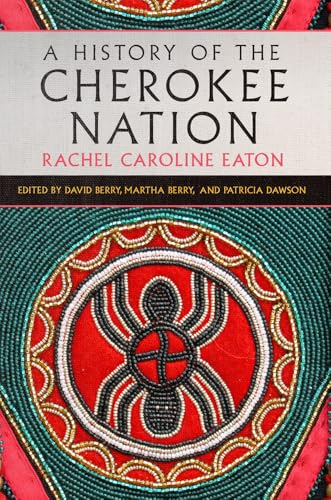 Patricia Dawson, co-editor, A History of the Cherokee Nation by Rachel Caroline Eaton (University of Oklahoma Press, 2025) 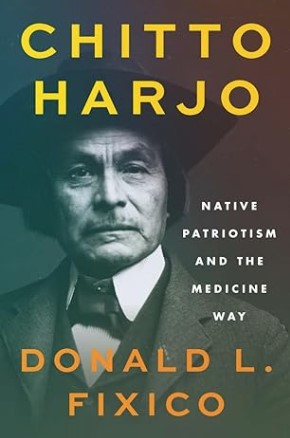 Donald L. Fixico, Chitto Harjo: Native Patriotism and the Medicine Way (Yale University Press, 2025) 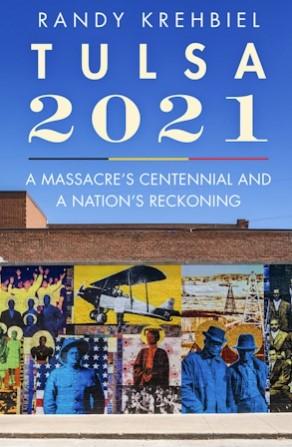 Randy Krehbiel, Tulsa, 2021: A Massacre’s Centennial and a Nation’s Reckoning (University of Oklahoma Press, 2025) 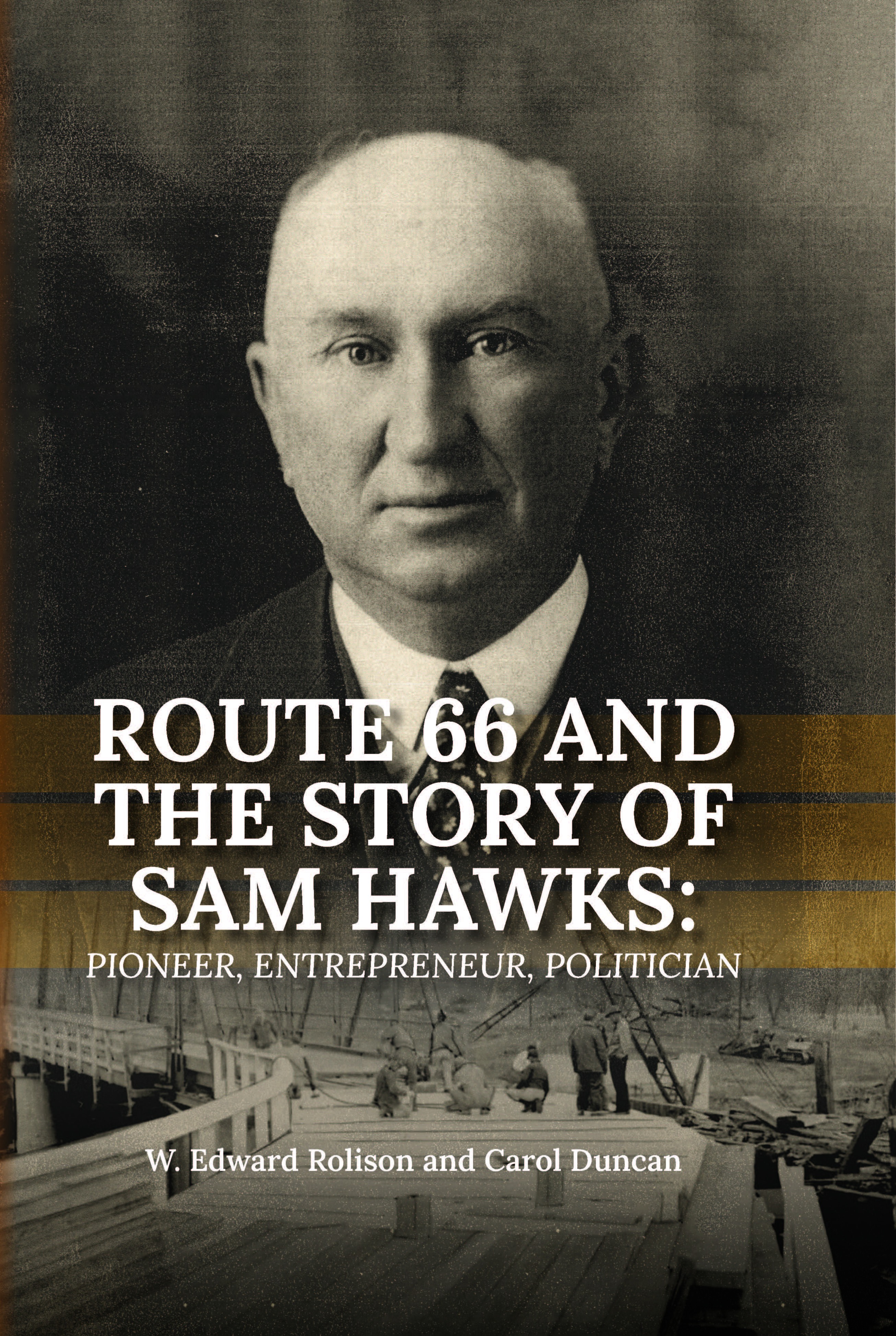 W. Edward Rolison, Route 66 and the Story of Sam Hawks: Pioneer, Entrepreneur, Politician by W. Edward Rolison and Carol Duncan (Oklahoma Hall of Fame, 2025) |
| 10:45 a.m.– 12:30 p.m. | Lunch Visit The ToGo Box, The ToGo Burger, and Oh Sugar Honey Iced Tea food trucks. |
| 11:30 a.m.–12:30 p.m. |
English speaks about his two decades as a US representative from Oklahoma and his leadership of the lobbying arm of America’s 900+ electric cooperatives. The electric co-ops are the ultimate “pull yourself up by your bootstraps” industry. Starting in the 1930s with President Franklin Roosevelt’s Rural Electrification Act, co-ops transformed rural America. Hear about a truly grassroots initiative that took hold and thrived in areas for-profit companies refused to serve. The co-ops are doing it again with high-speed broadband service, bringing modern life to rural areas. Our keynote sponsor is Oklahoma’s Electric Cooperatives. |
| 12:30–12:45 p.m. | Break |
| 12:45–1:30 p.m. |
“Creating Space: Real and Imagined Oklahoma Black Communities” This panel explores how Black Oklahomans utilized the township structure to cultivate safety and self-determination pre- and post-statehood. The presentations highlight the intersection of kinship, land, and community care. One paper traces a 1922 secessionist movement for an independent Black municipality near Tulsa. Another traces the life of a Black homesteading doctor who finds solace and confronts social issues in rural towns. The final presentation examines how African Creek families leveraged land allotments to secure political autonomy. Together, these studies interpret a legacy of reimagined spaces as essential engines for self-determination in political, social, and economic environments. “Chào to Main Street: The Effort to Resettle Vietnamese Refugees in Western Oklahoma” This presentation honors the 50th anniversary of the fall of the Republic of Vietnam government and the beginning of the Vietnamese community into Oklahoma. In 1975, Ordell and Mary Kluver, from Clinton, Oklahoma, found themselves immersed in a project to sponsor and help resettle over 200 Vietnamese refugees in rural areas in Western Oklahoma. They arranged for housing, education, and job placement. Today, the Asian community in Oklahoma is strong, and this session explores the genuine difficulties of introducing the Vietnamese people, with strong cultural traditions, into a vastly different, largely rural culture in the US. “Native Women, the Dawes Act, and Resilience: A Milestone in Oklahoma History” Federal policy initiatives like the Dawes Act had a devastating impact on Native people living in present-day Oklahoma. The forced assimilation of Indigenous people based on patriarchal gender roles in many ways upended traditional ways of living. Archival materials shed light on how the Dawes Act disempowered Native women but also how they resisted and used the same laws to their advantage. Women asserted power by strategically choosing adjoining plots and contesting laws, a practice largely prohibited for most white women in the late 19th century. |
| 1:30–1:45 p.m. | Break |
| 1:45–2:30 p.m. |
“Milestones in Oklahoma Indigenous History: From the Civil War in Indian Territory to the State of Sequoyah” This session explores various milestones in Oklahoma Indigenous history. From the Civil War and its impact on families, to the development of tribal systems to care for their citizens, and a multi-tribal push for an all-Indigenous state, this panel shares the various ways Indigenous people exercised personal and tribal sovereignty against the backdrop of increased settlement, land loss, and dispossession. “Myths and Realities of the Klan in Oklahoma, One Century Later” It has been a century since the Ku Klux Klan came to Oklahoma and seized power in a dramatic fashion, leading to a battle between the Invisible Empire and Governor Jack Walton between 1922 and 1923. The Klan's mercurial rise was matched by a precipitous decline only a few years later. The presentation describes the spectacular rise and fall of the second Klan in Oklahoma while seeking to make sense of this almost-forgotten episode can teach us today. “Testing Equality: Oklahoma’s Legal Landscape and the Evolution of the 14th Amendment” Did you know that Oklahoma helped shape US civil rights law? Oklahoma’s legal history isn’t just local—it’s national. Through 17 (and counting!) landmark US Supreme Court cases, Oklahoma’s legal history offers a revealing lens on the evolution of 14th Amendment jurisprudence. Far from peripheral, the state’s courts became arenas where the scope of equal protection was tested through education, transportation, reproductive autonomy, and land sovereignty cases. Thus, Oklahoma’s experience illustrates that constitutional rights are neither fixed nor self-executing. They also show that the fight for equality takes place in unexpected places through persistent advocacy and judicial intervention against systemic inequities. “A City Built By and On Oil: The Remorseless March of the Drills in Depression-Era Oklahoma City” In the spring of 1930 a new gusher, the Wild Mary Sudik, announced the discovery of what would be a large oilfield in central Oklahoma. Oklahoma City soon faced a choice: welcome the growth of the field or prohibit the production of oil in the more residential parts of the city. This is the story of how Oklahoma City arrived at its choice and how an oilfield altered, shaped, and defined Oklahoma City’s development. |
| 2:30–2:45 p.m. | Break |
| 2:45–3:30 p.m. |
“Myths, Mysteries, and Milestones in the Lives of Oklahoma Women” From the early days of statehood to its present, Oklahoma women have shaped the state’s historical narrative. The three women highlighted in this session illustrate the opportunities and limitations Oklahoma presented to women’s activism. Dr. Matthew Pearce presents on Ruth Clement, the creator of the state’s first flag. Dr. Sunu Kodumthara presents on Nelly Bunyan Jennings, a weekly columnist for Harlow’s Weekly who wrote about women’s political activism in Oklahoma. Dr. Sarah Janda presents on Karen Silkwood, the whistleblower whose activism and untimely death brought national attention to the environmental impact of Kerr-McGee. “‘From the Indian Territory to Indian Country’: McGirt v. Oklahoma, US (2020)” In McGirt v. Oklahoma in 2020, the US Supreme Court held that the Muscogee (Creek) Reservation still exists. The area the tribal nation governed expanded from 125,000 acres to 3.25 million. Subsequently, state courts have re-recognized that eight more tribes’ reservations from the 1860s still exist. Now, 49 percent of Oklahoma is “Indian Country,” and tribal and federal jurisdiction increased exponentially. To date, the State of Oklahoma has resisted this reality and litigation and controversy over multiple issues has occurred. How was the ex-Indian Territory once again recognized as Indian Country, and what kind of issues and litigation will arise in the future? “The Student Voice: Underground Newspapers at Central State College” From 1965 to 1975, Central State College (now the University of Central Oklahoma) in Edmond, Oklahoma, became a battleground for academic freedom amidst the tumultuous backdrop of the Vietnam War. Students and faculty openly opposed the administration. In lieu of open protests, students began writing and distributing off-campus newspapers to voice their displeasure with the war and the college with the support of various faculty members. This resulted in expulsions, firings, American Civil Liberties Union intervention, and a 26-year censure by the American Association of University Professors. Ultimately, the impact of these papers aided in shifting state policy against stifling academic freedom. |
| 3:30–3:45 p.m. | Break |
| 3:45–4:30 p.m. |
“Pioneers of Public Health: The Oklahoma Territory Pharmacists” When unregulated and addictive “medical” remedies arrived in Oklahoma Territory between 1890 and 1910, some of the first pharmacists began establishing professional associations in hope to somehow regulate them. We look back on the public health landscape being forged by several pioneer pharmacists, including Foress Ball Lillie, and the Territorial Board of Pharmacy that understood the dangers of “cure-alls” laden with alcohol, cocaine, and opium before the Food and Drug Administration was fully formed. We’ll tell these stories and more through our exhibits of 20th-century patent medicines on loan from the Oklahoma Frontier Drug Store Museum and the presenters’ private collections. “A Milestone for the Peyote Road: The 1918 Chartering of the Native American Church of Oklahoma and its Legacy for Native Nations Today” On October 10, 1918, Peyotists from tribal nations across Oklahoma chartered the Native American Church of Oklahoma to protect their religion under the First Amendment and—as stated in the Articles of Incorporation—to “cultivate a spirit of self-respect and brotherly union.” Many of the Native American Church’s founding members attended boarding schools and returned home in critical condition. In their sacred medicine, peyote, they received a path for healing physically, emotionally, and spiritually. During this session, speakers present how their advocacy for the right of Native people to follow the Peyote Road continues to empower Native sovereignty. “Borderlands, Assimilation, and a Red River Rivalry: The Legacy of Polonia in Harrah, Oklahoma” Bax examines the Polish community in Harrah, Oklahoma, the neighboring Citizen Potawatomi Nation, and the first permanent Polish settlement in the United States in Panna Maria, Texas. Originally settled by ten Polish families during 1891–92, Harrah is a borderlands community that experienced a resurgence of ethnic pride in the late 1970s but later assimilated into the dominant white American society because of its proximity to Oklahoma City, dilution, and lack of local government control. In contrast, the Citizen Potawatomi Nation retained its Native American identity due to its status as a separate sovereign and tribal institution, while Polonia endured in Texas. |
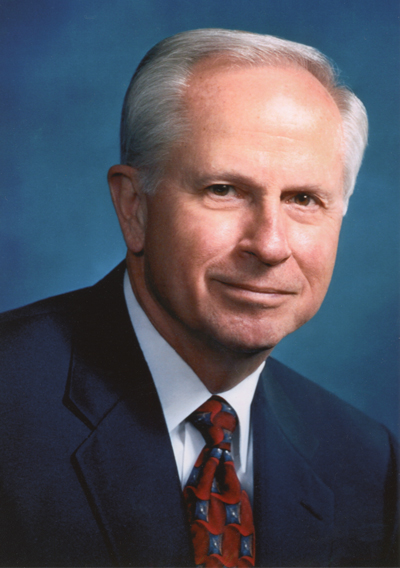 Welcome and Keynote
Questions?
Please contact Tory Tedder-Loffland at 405-522-0843 or [email protected].
Materials from Oklahoma Historical Society collections pictured above, left to right:
Oklahoma City Oil Field, 1930 (21412.BH8.A, Z.P. Meyers/Barney Hillerman Photographic Collection)
Native American leaders and medical officials meet for hearing on peyote and mescal, Guthrie, 1908 (13741, Frank F. Finney Sr. Collection)
Drug store in Sulphur, c. 1901 (2153.19, Joseph F. Swords Collection)
Proposed state of Sequoyah, 1905 (ITMAP.FOREMAN.0006, Grant Foreman Collection)
Vietnamese refugees arrive in Fort Smith, 1975 (2010.011.B128.0141, Oklahoma Journal Photography Collection)
Explore Past Events
2025 Oklahoma History Symposium
2024 Oklahoma History Symposium
2023 Oklahoma History Symposium
2022 Oklahoma History Symposium
2021 Oklahoma History Conference (virtual)