World War I and The Art of War
Timeline
1914
June 1914 – Franz Ferdinand, archduke of Austria-Hungary, and his wife Sophie are assassinated
July 1914 – Austria-Hungary declares war on Serbia
August 1914 – Germany declares war on Russia, France, Belgium, and invades France
Britain declares war on Germany and Austria-Hungary
US declares its neutral stance
France declares war on Austria-Hungary
Japan declares war on Germany
Austria-Hungary declares war on Belgium and invades Poland (Russian)
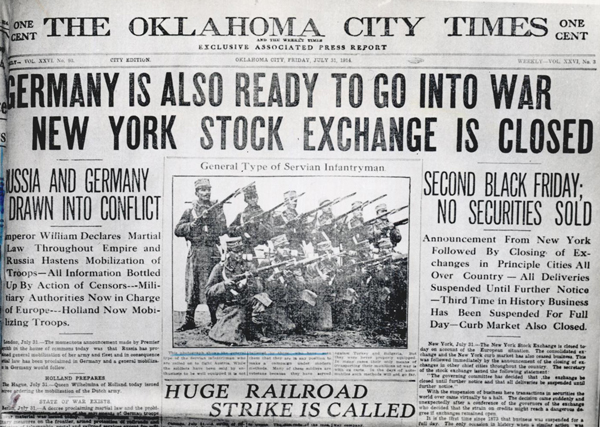
The Oklahoma City Times from July 31, 1914 (2012.201.B1349.0893, Oklahoma Publishing Company Photography Collection, OHS).
1915
January 1915 – Bread rationing introduced in Germany
May 1915 – German U-boat torpedoes the civilian ship Lusitania, including 128 US citizens

A photograph of the Lusitania leaving New York Harbor (image courtesy of the Library of Congress).
1916
June 1916 – National Defense Act signed into law expanding the size and scope of the US military
November 1916 – Woodrow Wilson is reelected
1917
February 1917 – US severs relations with Germany
April 1917 – US declares war on Germany and officially enters World War I
May 1917 – Selective Service Act
June 1917 – Espionage Act
First US Troops arrive in France
First Liberty Loan
July 1917 – First lottery of draft
December 1917 – The Eighteenth Amendment is passed and prohibition begins
1918
January 1918 – 14 Points
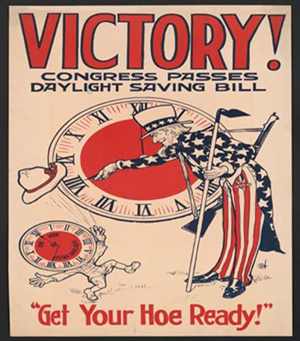
Poster promoting the Daylight Saving bill (image courtesy Library of Congress).
March 1918 – Daylight saving time begins in the United States
November 1918 – Armistice (eleventh day, eleventh month, eleventh hour) World War I ends

Men, women, and children celebrate in the Paris streets on Armistice Day (image courtesy of the Library of Congress).
1919
January 1919 – Peace conference in Paris
February 1919 – League of Nations created
June 1919 – Germany and Allies sign the Treaty of Versailles
July 1919 – Treaty of Versailles is submitted to the Senate
August 1919 – The Nineteenth Amendment passed by Congress giving women the right to vote
November 1919 – Treaty of Versailles not ratified by Senate

This political cartoon shows a man representing the US Senate looking perplexed by the huge Peace Treaty scroll left by President Wilson (image courtesy of the Library of Congress).