The Encyclopedia of Oklahoma History and Culture
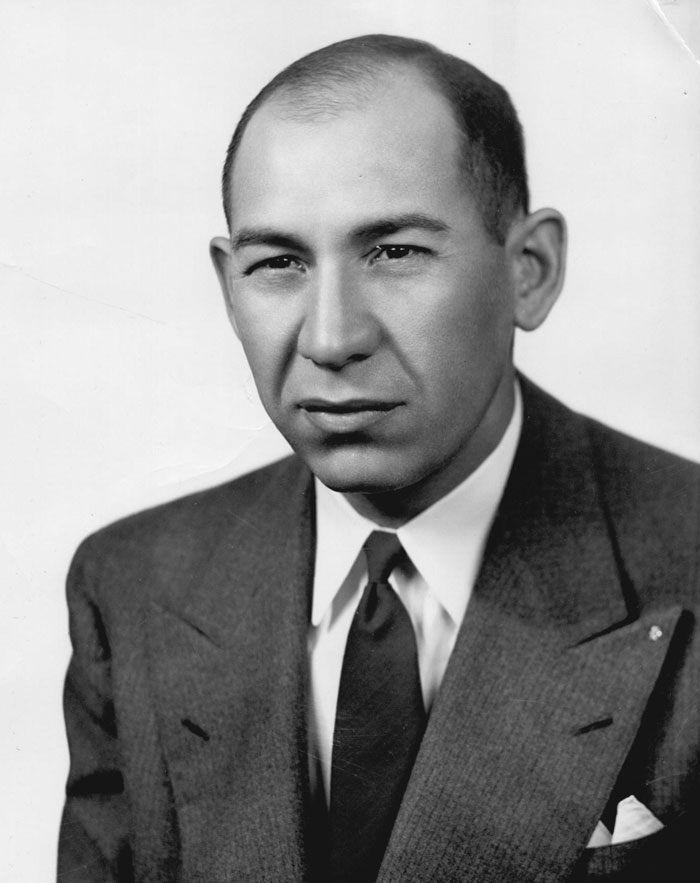
(2012.201.B1083.0606, Oklahoma Publishing Company Photography Collection, OHS).
JESSE BARNARD RENICK (1917–1999).
Jesse Barnard Renick, known as “Cab,” is one of three American Indians to win a gold medal in the Olympic Games. He was born on September 29, 1917, in Love County, Oklahoma. His mother, Ella Waytubby Renick, had Chickasaw and Choctaw ancestry, while his father, Miles, had Irish roots. Ella Renick died when her son Cab was six years old, leaving him with few direct connections to his mother’s Native language and culture. He grew up in a rural farming community in Oklahoma, immersed in white American culture. His youth was markedly different from the other two American Indian athletes to win gold: Jim Thorpe, who attended Carlisle Indian Boarding School, and Billy Mills, who grew up on the Pine Ridge Reservation in South Dakota.
After graduating from a rural high school in 1934, Renick made his way to Murray State, a junior college in Tishomingo, Oklahoma, where he began to make his name on the basketball court, earning the nickname “Point-a-Minute Renick.” In 1938 he moved on to Oklahoma A&M (now Oklahoma State University), where he competed for legendary basketball coach Henry “Hank” Iba. An all-around player, Renick led the Aggies in scoring for two straight seasons while also playing stalwart defense, capping off his college career in 1940 with All-American honors.
Renick served in the U.S. Navy during World War II and afterwards returned to Bartlesville, Oklahoma, where he earned a spot on the Phillips 66ers, a leading Amateur Athletic Union (AAU) basketball team sponsored by Phillips Petroleum. With Renick and seven-footer Bob Kurland, a fellow Oklahoma A&M graduate, leading the way, in 1948 the 66ers won an Olympic qualifying tournament, giving the team five spots on the U.S. Olympic roster. Renick served as a captain as the American squad swept through the competition in London, easily winning the gold. Afterwards, Renick retired from playing basketball, spending a few years coaching before getting into business.
During his playing days, newspapers often described Renick in stereotypical ways, labeling him as “chief” or describing him as being on the “warpath.” Renick, however, took pride in his Chickasaw and Choctaw identity and what his athletic achievements meant for the broader American Indian community. “There’s only three Native Americans who have won a gold medal” he informed a reporter later in life. “There’s Jim Thorpe, who was Sac and Fox; Billy Mills, who was a fighting Sioux; and myself.”
Renick passed away in Ardmore, Oklahoma, on November 25, 1999, at eighty-two years old. He has been inducted into the American Indian Hall of Fame (1973), the Chickasaw Nation Hall of Fame (1996), and the Oklahoma State University Hall of Fame (1999).
See Also
BASKETBALL, HENRY PAYNE IBA, ROBERT ALBERT KURLAND, ALLIE PIERCE REYNOLDS, JAMES FRANCIS THORPE
Learn More
Richard Green, “The Peacemaker,” Journal of Chickasaw History 4 (November 1998).
Joseph Oxendine, American Indian Sports Heritage (Lincoln: University of Nebraska, 1995).
Paul Putz, “Jesse ‘Cab’ Renick: In Search of an Indian Identity,” The Chronicles of Oklahoma 89 (Spring 2011).
“Jesse ‘Cab’ Renick,” Vertical File, Research Division, Oklahoma Historical Society, Oklahoma City, Oklahoma.
Citation
The following (as per The Chicago Manual of Style, 17th edition) is the preferred citation for articles:
Paul E. Putz, “Renick, Jesse Barnard,” The Encyclopedia of Oklahoma History and Culture, https://www.okhistory.org/publications/enc/entry?entry=RE043.
Published November 4, 2026
© Oklahoma Historical Society