Fort Towson Historic Site
The Fort Towson Historic Site visitor center offers engaging exhibits that delve into the fort’s rich history, from its construction in 1824 to its role in the Mexican-American War and the Civil War. Visitors will discover the story of nearby Doaksville, first established as a trading post that later became a thriving commercial center and capital of the Choctaw Nation.
Guests can also explore the history of the steamboat Heroine, which sank in 1838 on its way to the fort. An exhibit dedicated to the Heroine and other steamboats used to ferry people and resources to the region includes a detailed model and artifacts recovered from the wreck.
The site brings history to life through the 1840s Encampment and Education Day each spring, Candlelight Tours in the fall and winter, and events and demonstrations throughout the year.
Join our email list to keep up to date with happenings at Fort Towson Historic Site.
History of the Fort
Fort Towson was established in 1824 to quell conflicts between lawless elements, American Indian peoples, and settlers claiming the area as part of Arkansas Territory. The fort also served as an outpost on the border between the United States and Texas, which at that time was part of Mexico. Connected to the East by road, Fort Towson served as a gateway for settlers bound for Texas during the 1830s. Those passing through the area included Sam Houston, Davy Crockett, and Stephen F. Austin. When the Choctaw and Chickasaw were displaced from their lands in the southeastern United States, the fort served as a point of dispersal upon their arrival in the West. The fort was also an important staging area for US forces during the Mexican War of 1846.
Fort Towson was abandoned in 1854 when the frontier moved West. During the Civil War, however, it served for a time as headquarters for Confederate forces operating in Indian Territory. In 1865 General Stand Watie surrendered his command near the fort and became the last Confederate general to lay down arms.
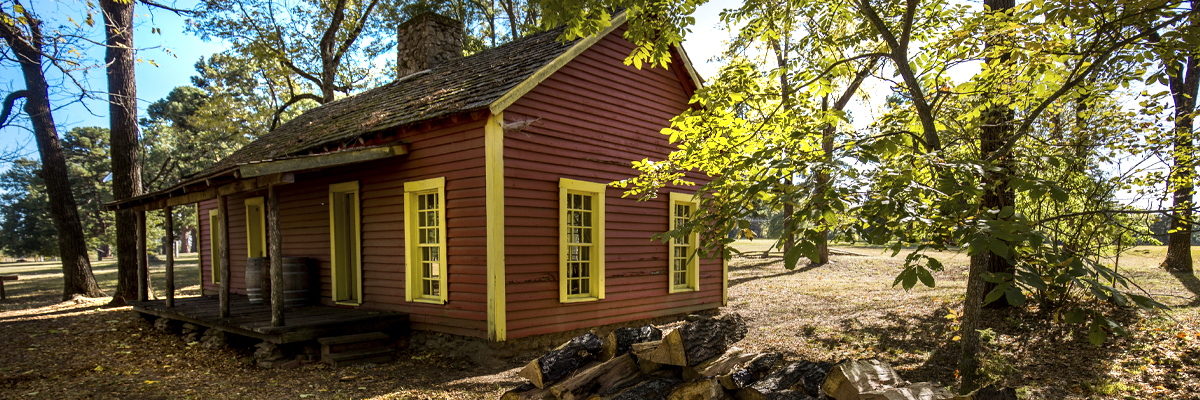
When the Oklahoma Historical Society acquired the site in the 1960s, little remained to portray its former importance. Today, a visitor center, reconstructed sutler store, teamster’s cabin, and a walking trail of historic ruins chronicle the story of the fort. Fort Towson Historic Site is listed in the National Register of Historic Places.
Visit The Encyclopedia of Oklahoma History and Culture to find out more about Fort Towson’s history.
Our Newsletter
 Read our PDF newsletter for updates about Fort Towson Historic Site!
August 2026
February 2026
August 2025
February 2025
Explore More
- Read about the steamboat Heroine in The Encyclopedia of Oklahoma History and Culture.
- View the Steamboat Heroine e-exhibit
- “Shipwrecked in Oklahoma: The Last Voyage of the Steamboat Heroine, 1838” from The Chronicles of Oklahoma
- “Flames on the Frontier: Archeology at Fort Towson Commanding Officer's Quarters” from The Chronicles of Oklahoma
- Fort Towson Historic Site on YouTube