Government
The Defining Documents of the State of Oklahoma
Sequoyah Constitution
As part of the negotiation for the removal of the Five Tribes in the 1830s, the US government agreed that once removed, the tribes would never be “embraced in any Territory or State.” As westward expansion drove settlers across the continent, American Indian nations in Indian Territory were content to remain exactly as they were. However, the Curtis Act of 1898 forced these tribes to break up communal lands into private land plots and abolish their tribal governments. The tribal nations attempted to retain their sovereignty by cooperating and writing a constitution. They were concerned that Indian Territory would be combined with Oklahoma Territory. They organized the Sequoyah Convention of August 21, 1905, in Muskogee, part of the Muscogee (Creek) Nation, in order to exercise control on the march toward statehood. The convention attendees advocated for Indian Territory to be admitted as its own state.
Four of the Five Tribes sent their chiefs to the convention. Chickasaw Governor Douglas Johnston refused to go to the convention because he thought the Indian Territory and Oklahoma Territory would be combined anyway. In his place, he sent William “Alfalfa Bill” Murray instead.
The Sequoyah Constitution was signed on October 14, 1905, in McAlester. The Constitution was approved with 56,279 for and 9,073 against on November 7, 1905.
During the 59th Congress, Senator Porter James McCumber of North Dakota and Representative Arthur Phillips Murphy of Missouri, who was also the attorney for the Muscogee (Creek) Nation, filed statehood bills for the state of Sequoyah. However, their proposal went nowhere as the Republican Congress refused to consider it because they feared another Democratic state, as the Democratic Party heavily influenced Indian Territory.
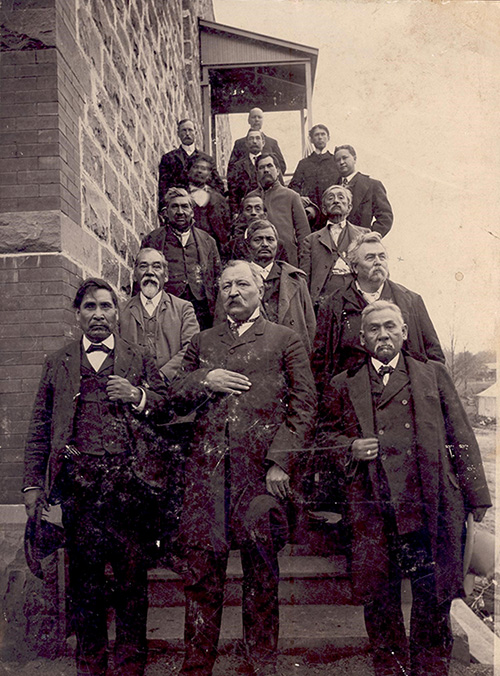
Delegates to the Sequoyah Convention (576, Oklahoma Historical Society Photograph Collection, OHS).
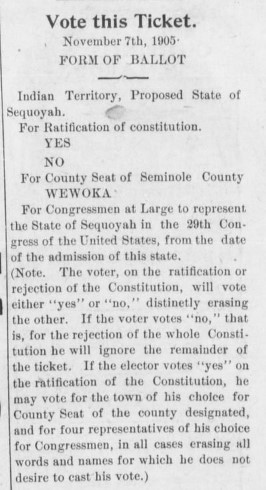
A copy of the ballot from the Wewoka Herald, November 3, 1905.
The text of the November 3, 1905, ballot from the Wewoka Herald reads:
Vote this Ticket.
November 7th, 1905
Form of Ballot
Indian Territory, Proposed State of Sequoyah.For Ratification of constitution.
YES
NOFor County Seat of Seminole County
WEWOKAFor Congressmen at Large to represent the State of Sequoyah in the 29th Congress of the United States, from the date of the admission of this state.
(Note. The voter, on the ratification or rejection of the constitution, will vote either “yes” or “no,” distinctly erasing the other. If the voter votes “no,” that is, for the rejection of the whole Constitution he will ignore the remainder of the ticket. IF the elector votes “yes” on the ratification of the Constitution, he may vote for the town of his choice for County Seat of the county designated, and for four representative of his choice for Congressmen, in all cases erasing all works and names for which he does not desire to cast his vote.)
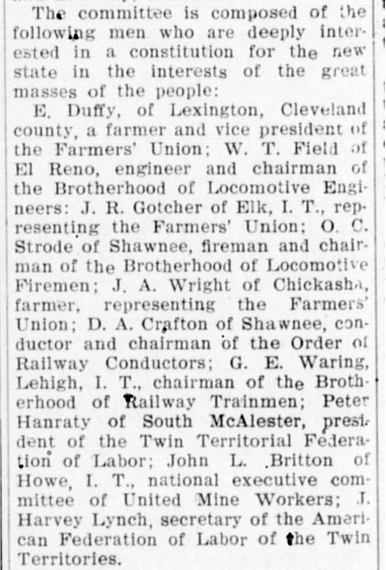
A list of the committee members who wrote the Shawnee Demands (The Labor Signal and Oklahoma State Labor News, September 21, 1906).
Shawnee Demands
After the failure of Congress to accept the Sequoyah Constitution, it was clear that the two territories would come in as one state. After passage of the Enabling Act in June 1906, different groups began organizing to ensure that the new Oklahoma Constitution would include rules that they thought important. During this time, many believed that regulation of the economy by the government was a good solution to problems that developed with industrialization. Many people also believed that the government should have rules protecting vulnerable groups from abuse, such as workers, children, women, and farmers. Those who wanted rules that reflected these values were called progressives. Oklahoma had many progressives, both voters and those writing the constitution. Progressives, both in and outside Oklahoma, were excited to have the opportunity to write a new constitution to serve as a model constitution for a modern state.
Different people and organizations in the state shared their ideas about what should go in the constitution to the delegates who would write it. The most important example of this advocacy is the Shawnee Demands, or the “24 Demands.” In August the Twin Territories Federation of Labor, the Oklahoma Farmer’s Union, and several groups of railroad workers met to make a list of suggestions for the constitution. These groups represented a majority of the workers in the state. They developed a list with 24 demands, which was approved and released on September 10, 1906. They wanted the constitution to include:
- The initiative, referendum, and recall
- Mandatory education and free textbooks printed by the state
- An eight hour day for miners and government workers
- A corporate tax commission to ensure corporations were paying the correct amount of taxes
- A ban on using convict labor
- A ban on child labor in mines, mills, and factories
- A ban on gambling in farm products
In her diary, Kate Barnard wrote that the Democrats, the largest party in Oklahoma at the time, embraced the “24 Demands” and potential delegates campaigned on them. The vast majority of these proposals were written into the constitution. Oklahoma’s Constitution is considered one of the most progressive, and longest, constitutions to be adopted.
The Oklahoma Constitution
Advocates for combining the territories and proceeding toward statehood succeeded, and the Oklahoma Enabling Act of 1906 was passed by Congress. This act, signed by President Roosevelt, let the registered voters of Indian Territory and Oklahoma Territory elect delegates to a state constitutional convention. These delegates were to draft a state constitution, allowing them to petition for statehood.
After weeks of deliberation, the constitution was set before voters on September 17, 1907, on the 120th anniversary of the adjournment of the Constitutional Convention. The delegates of this Constitutional Convention took pieces of other state constitutions, the Sequoyah Constitution, as well as the US Constitution, to create the Oklahoma Constitution we know today.
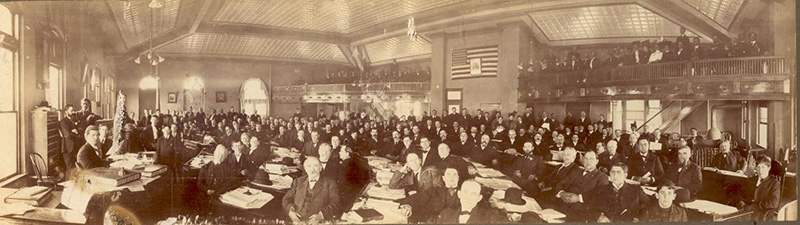
A session of the Oklahoma Constitutional Convention, photograph by Fred S. Barde, 1907 (11438.B, Oklahoma Historical Society Photograph Collection, OHS).
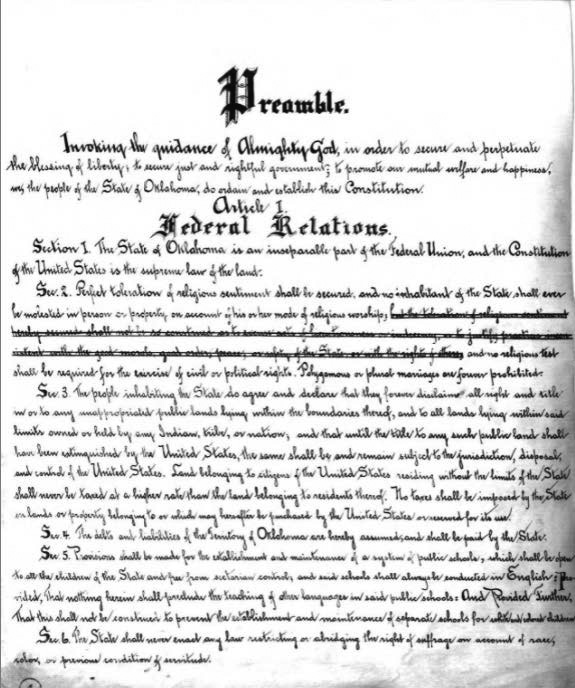
This is an image of the original handwritten constitution of Oklahoma (OHS).
The Oklahoma Constitution is longer and more specific than the US Constitution. It serves as the supreme law of the land for Oklahoma. The Oklahoma Constitution has a preamble and thirty articles. It establishes the executive, legislative, and judicial branches of the Oklahoma government as well as regulations of banking, the process of constructing public roads, and the rules regarding suffrage. Most constitutions do not include so many fine details. As Oklahoma was moving toward statehood, many voters within the United States concluded that the government has a responsibility in regulating business and in protecting the public. This general trend was called Progressivism. Many popular politicians in most of the parties promoted Progressive ideals, including Theodore Roosevelt and Woodrow Wilson. In Oklahoma, many state leaders were also Progressives. This belief that the government had many responsibilities can be seen throughout the Oklahoma Constitution.
Want to explore the Constitution? Head to oklegislature.gov/ok_constitution.html
Oklahoma’s Government
Oklahoma’s Legislative Branch
Similar to Congress at the federal level, the Oklahoma Legislature is bicameral with a House of Representatives and a Senate. The House is led by the speaker of the house, and the Senate is led by the lieutenant governor. Another difference between the two legislatures is their size. As established by the US Constitution, the US Senate consists of two senators per state, while the US House is legally set at 435 members. The house members represent a geographic district within a state, while the senators represent all the people of a state. The Oklahoma legislative bodies are different because they follow the guidelines of the Oklahoma Constitution. The Oklahoma Senate has 48 members because there are 48 senate districts in Oklahoma. Each district gets a senator. The Oklahoma House has 101 members because there are 101 house districts. A district is an area that votes for a representative. Every ten years, the districts change shape based on the new population figures released after the census. Each district is supposed to have close to the same population as the other districts. Over ten years, as people move, the populations shift, and the districts are redrawn to balance the populations. This is called redistricting.
The state legislature meets in Oklahoma’s Capitol in Oklahoma City. Each legislative term is two years and has two sessions. The first session is the year after the most recent statewide election and the second is the year after. The legislature usually meets from January to May for a regular session. Sometimes, they meet at irregular times if there is an important matter that cannot wait. This is called a special session.
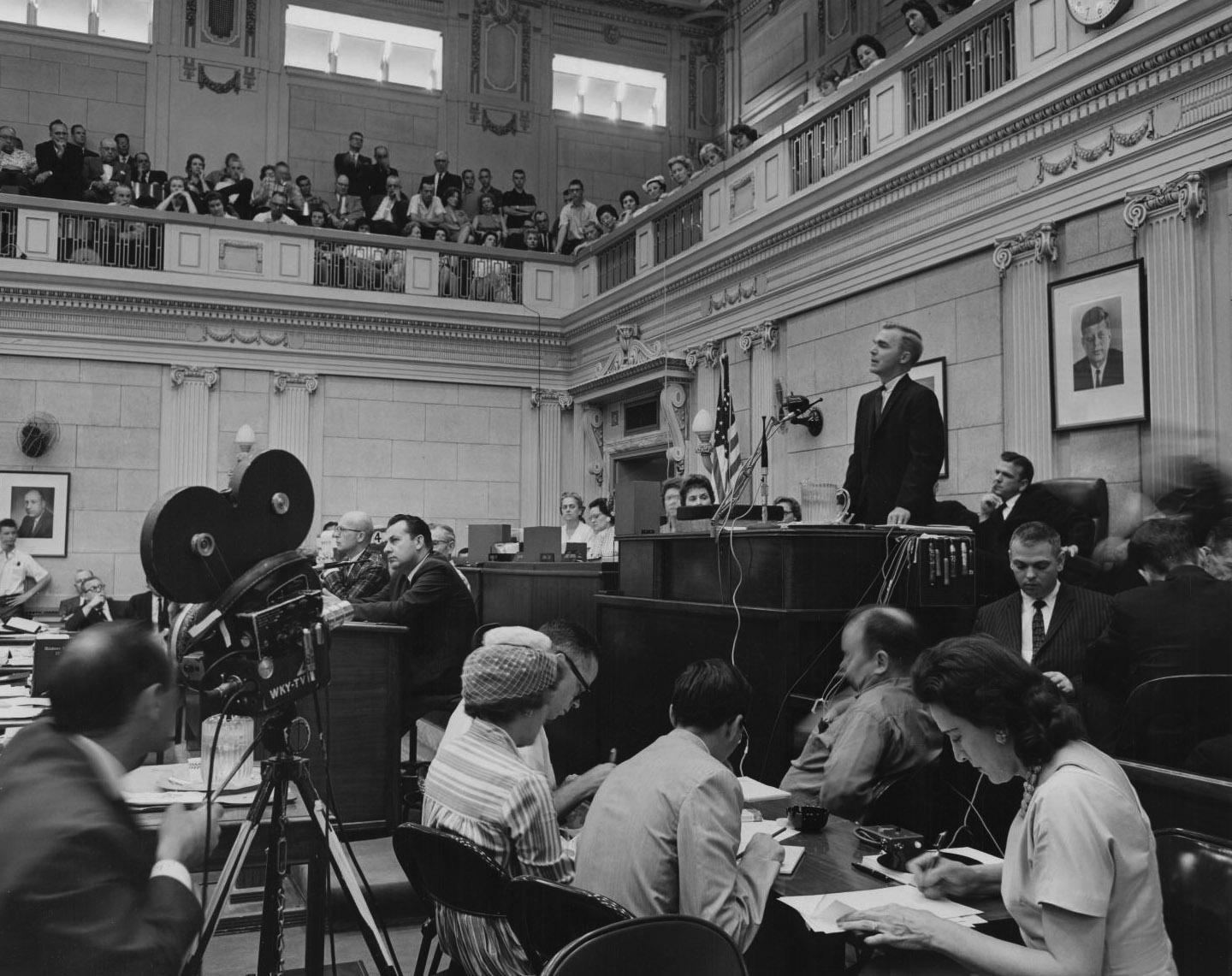
The House and Senate chambers at the Oklahoma State Capitol can be bustling with staff, press, lobbyists, and concerned citizens during the legislative session, shown here in 1961 (2012.201.OVZ001.10910, Oklahoma Publishing Company Photography Collection).
Oklahoma’s Executive Branch
Like the US government’s president, Oklahoma has a head of the executive branch: the governor. The governor, like the president, has the job of enforcing laws and vetoing legislation. Additionally, the lieutenant governor is a role similar to the vice president. The lieutenant governor also leads the state senate and serves as a tiebreaker for senate votes.
The executive branch includes state agencies that conduct state business. Each of the agencies specializes in an area of responsibility. For example, the state Department of Education oversees the schools in the state. The Department of Environmental Quality works to ensure our air, water, and land are clean.
The state executive has a cabinet to advise, much like the president’s cabinet. However, in Oklahoma specifically, the secretary of state has an additional responsibility: American Indian affairs. On the federal level, the secretary of the interior meets with American Indian nations. The Oklahoma secretary of state has roles similar to roles of the federal secretaries of state and interior. This is necessary because there are so many Native nations within Oklahoma; these governments need close cooperation. The executive branch needs to have someone in charge of overseeing this work.
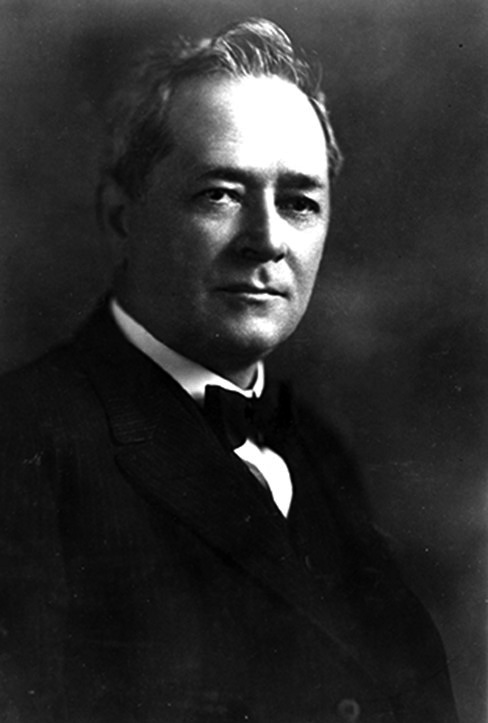
Charles N. Haskell, first governor of Oklahoma (6091, Oklahoma Historical Society Photograph Collection, OHS).
Oklahoma’s Judicial Branch
Like the federal judicial branch, the Oklahoma judicial branch has levels of courts. Unlike the federal branch, judges are elected for the municipal and district courts. The governor appoints judges for the Courts of Appeals and the Supreme Court.
Municipal Courts
Municipal courts are on the city level of government. They have limited judicial power and mainly focus on misdemeanor crimes within the community. An example of a misdemeanor crime would be a speeding ticket given by a police department.
District Courts
The next level of court is where the majority of cases are heard. These are also called courts of general jurisdiction. There are 77 district courts across Oklahoma for the 77 judicial districts organized by county. This court hears criminal trials and civil lawsuits.
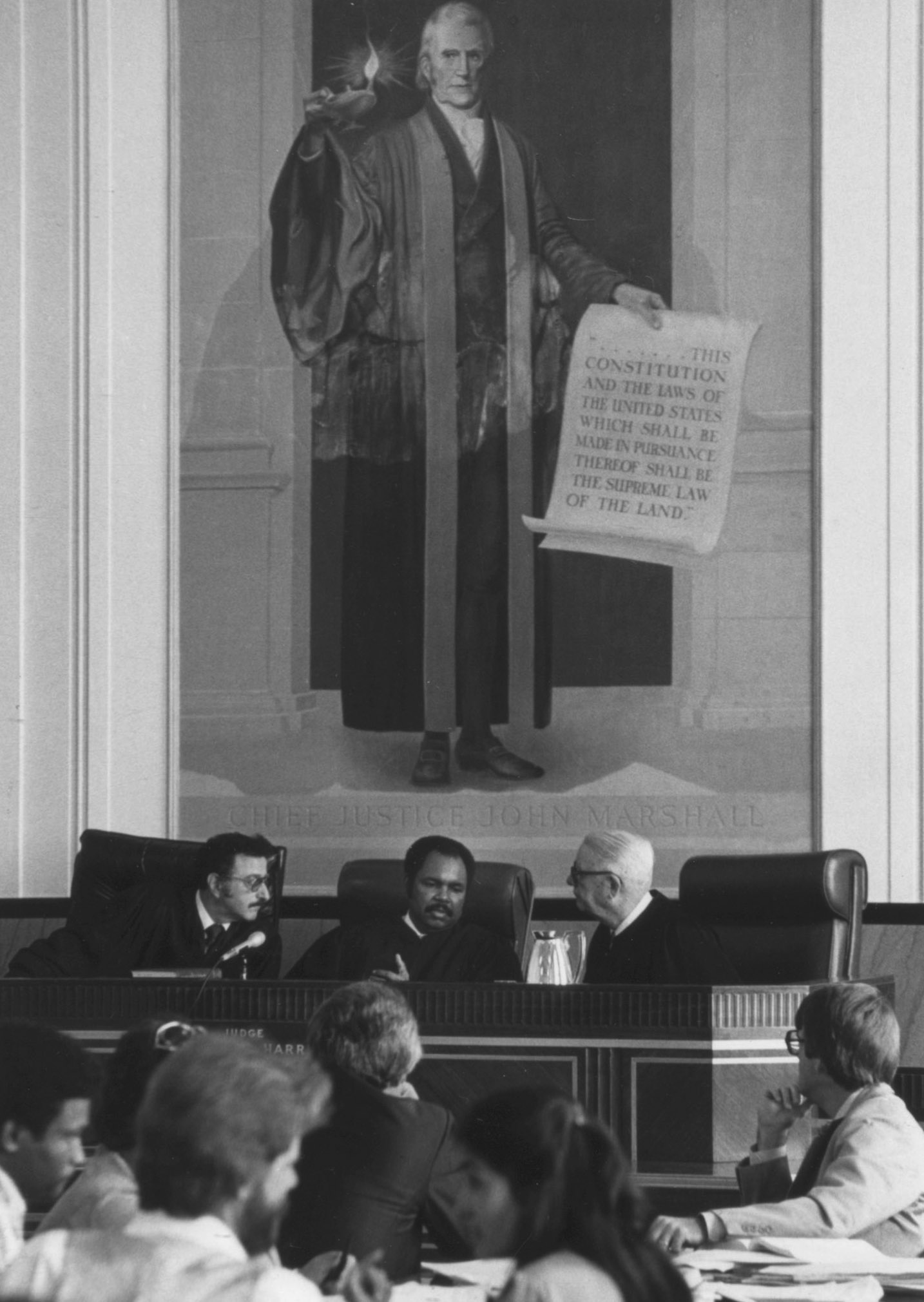
Oklahoma County District Court Judges Raymond Naifeh, Charles Owens, and Carmon Harris determined an ongoing strike could legally prevent the local teachers union from being recognized as a bargaining unit by Oklahoma City Schools, 1979 (2010.011.B097.0570, Oklahoma Journal Photography Collection, OHS).
Court of Appeals
These courts are the next level of the judicial branch and are split into two types of courts. Their objective is to determine if the law was applied correctly in the municipal or district court. Courts of appeals do not retry the case; they simply make sure the law was applied correctly. There are two types in the State of Oklahoma.
- Court of Criminal Appeals - This is Oklahoma's highest court for criminal cases. It looks at appealed cases that deal with crimes. It has five judges.
- Court of Civil Appeals - This court is the next level for civil cases. Civil appeals also go to the state Supreme Court. There are twelve judges in this court, divided into four groups of three. A three-judge panel will hear a case and deliver an opinion.
Supreme Court
The Supreme Court is the highest court in the state of Oklahoma for civil cases. The Oklahoma judicial system is special because it has two high courts for cases. The Court of Criminal Appeals is the highest court for criminal cases, and the Supreme Court is the highest court for civil cases, especially those dealing with the Constitution.
County Government
The state constitution establishes county governments to help divide the state into smaller pieces to assist in administration. This level of government serves the state and enforces its laws. They also assist municipalities by providing road, bridge, and fire services. There are seventy-seven counties in the state of Oklahoma, each with a county seat.
While every county is different, they are all organized in the same way. Each county is governed by eight elected officials and a district attorney.
Board of County Commissioners
Three of the eight elected officials are called county commissioners. They serve as a quasi-head of government and are elected from three equally sized districts within the county.
County Sheriff
The county sheriff is the chief law enforcement officer. They enforce court decisions and other laws within the county. The deputies in the sheriff’s department will spend their time enforcing traffic laws, investigating crimes, serving warrants, and conducting evictions. They usually also operate the county jail.
District Attorney
The district attorney serves as the chief prosecutor for the county. They are responsible for deciding which criminal cases to prosecute and representing the country in court. In addition to the funding the office receives from county government, the office collects fees from individuals convicted of crimes. The district attorney uses this money to operate.
County Clerk
One of the eight elected officials, the county clerk keeps track of the records of the county and serves as the secretary for the county commission. These records include property deeds, real estate records, and legal documents.
District Court Clerk
The district court clerk keeps records for the criminal and civil cases of the district court. These records can include marriage licenses, divorce decrees, and adoption certificates. The court clerk’s office is responsible for ensuring the county court system runs smoothly and is also charged with collecting court costs required of people involved with the court system. They publish court records so that the public can access them.
County Assessor
The county assessor establishes the market and tax value of property in the county. They give these reports to the county treasurer for the county budget. Property taxes are important because they fund most of the county's budget. The county assessor keeps property records and makes them available to the public.
County Treasurer
They collect taxes confirmed by the county assessor. They also serve as the official keeper of county funds.
Municipal Government
Municipal, or city, governments are also established by the state constitution to help govern the state more effectively. It is a more direct form of government because the leaders making decisions about the town live there and are a part of the community.
City Executive
Like the US government, the town or local executive branch has a head called the mayor. The role of the mayor can vary depending on what form of municipal government the city or town uses: the mayor-council (also known as strong mayor) and the council-manager systems (also known as weak mayor) are the two most common in Oklahoma. It is their responsibility to enforce the law in their town as well as work with the other branches of the town government. Tulsa uses the mayor-council form of government. The other common way of running the city adds a city manager to the city executive branch. In this system, the mayor gives up their day-to-day responsibilities but still decides on policy with the city council. This type of system is used in Oklahoma City. For example, both Tulsa and Oklahoma City recently needed to hire a police chief, but they approached it differently. In Tulsa’s strong-mayor system, the mayor picked and hired the police chief. In Oklahoma City’s weak-mayor system, the city manager decided and hired the new chief.
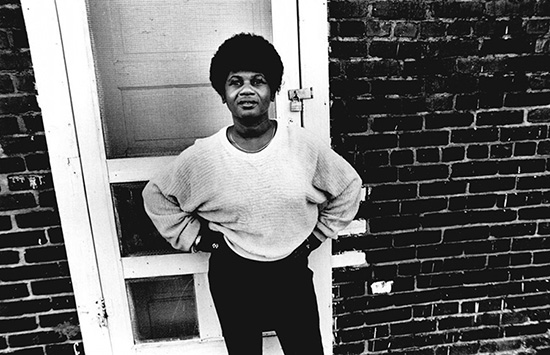
Lelia Foley was the first Black woman mayor elected in the nation when she became mayor of Taft, Oklahoma, in 1973 (2012.201.B0154.0529, Oklahoma Publishing Company Photography Collection, OHS).
City Legislature
This is called the city council and is made up of councilors coming from different wards or districts in the city. They come up with laws called ordinances and they adopt them as a group through voting. In Oklahoma, cities and towns made decisions about land use, street maintenance, parks, sanitation and water service. They also have their own fire and police departments.
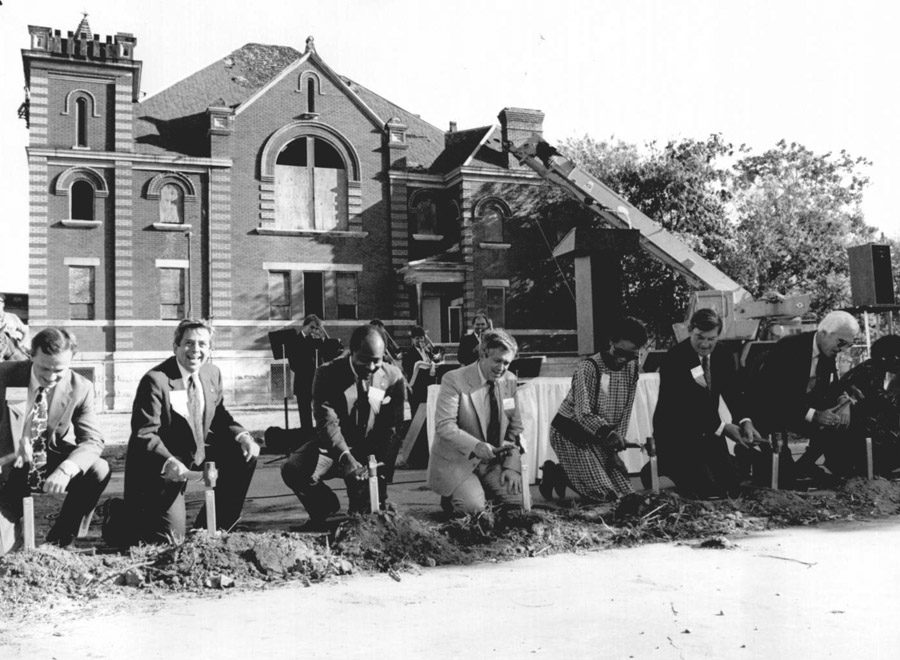
State, city, and county officials collaborate with non-profits and private contractors to complete infrastructure projects and provide services.
For example, HTP Incorporated completed historic preservation of the Maywood Presbyterian Church in Oklahoma City by partnering in 1988 with Lieutenant Governor Robert S. Kerr, City Manager Terry Childers, Oklahoma County Commissioner Shirley Darrell-Daniels, Bill Purtle of the University of Oklahoma Foundation, Orvil Tate for the International Brotherhood of Electrical workers, and Alva Boyd of the Harrison-Walnut Redevelopment Corporation (2012.201.B0268.0228, Oklahoma Publishing Company Photography Collection, OHS)