The Story of the Capitol
Art Collection
The State Capitol houses an impressive art collection including murals, paintings, and sculpture. The pieces reflect the rich and diverse history of Oklahoma. Highly respected artists created these works to share with everyone who visits the Capitol.
Outside, a large sculpture entitled As Long as the Waters Flow reminds visitors that the land upon which the Capitol is built was originally land owned by tribal nations. This is represented in the form of an American Indian woman. This sculpture was created by Allan Houser (Chiricahua Apache). Other pieces of his work can be seen at the Oklahoma History Center, the Sam Noble Museum of Natural History, the United Nations, and the National Portrait Gallery in Washington, DC.
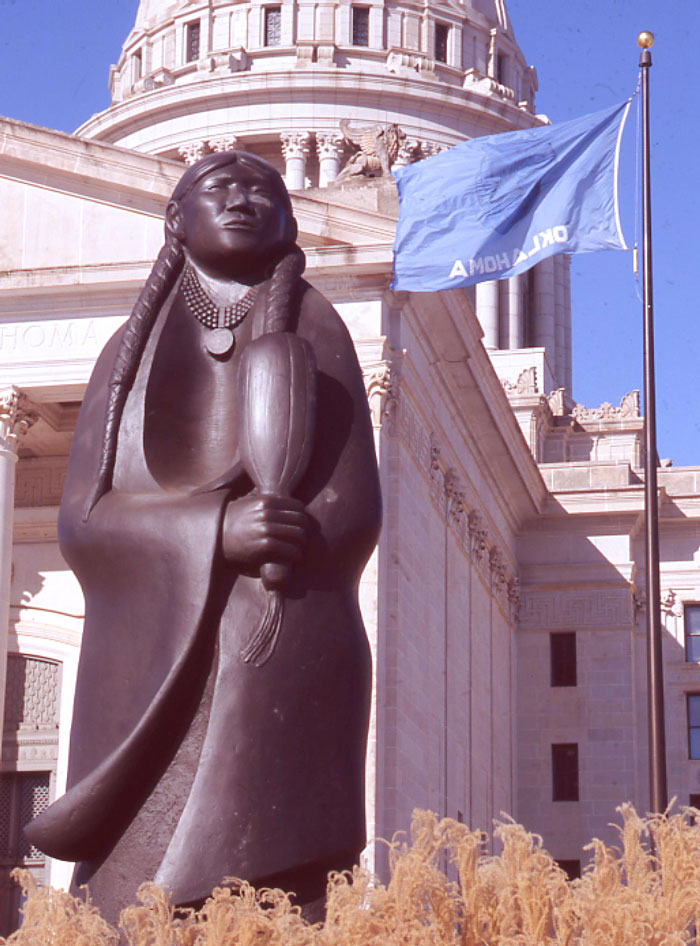
As Long as the Waters Flow stands on the grounds of the Capitol. It was dedicated in 1989 (23389.5.41, Jim Argo Collection, OHS).
Inside the capitol are several murals painted by Charles Banks Wilson. These murals create a timeline of Oklahoma history. The first shows the Coronado expedition exploring the land that will become Oklahoma. The second depicts trade between different fur traders and American Indian hunters while a fort, showing the presence of the military, can be seen in the background. The third mural presents the Indian removals to Indian Territory in the 19th century. The final mural shows later settlement through a depiction of the Land Run of 1889.
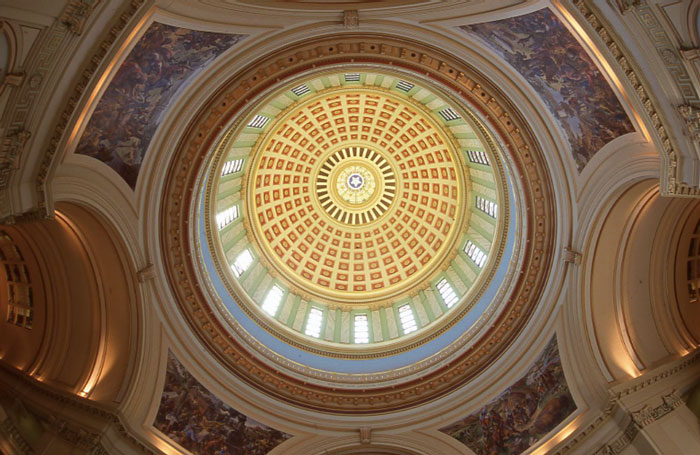
Murals on the ceiling of the Capitol around the dome’s interior. In the center of the dome is a stained-glass window of the Oklahoma State Seal (23389.5.41, Jim Argo Collection, OHS).
Other murals celebrate the cultural impact of the Five Moons, a group of Indigenous ballerinas from Oklahoma; the oil and gas industry; and farming and ranching. The first 100 years of Oklahoma’s history is celebrated in Carlos Tello’s Beyond the Centennial, dedicated in 2010.
The people who helped make Oklahoma what it is today are also celebrated through artworks at the State Capitol. Artists captured numerous well known Oklahomans in portraits and sculptures throughout the building.
Below is a list of some of the individuals represented. Use the links below to learn more about each Oklahoman in The Encyclopedia of Oklahoma History and Culture.