Historical Marker Program
Search Results
Your search returned 12 results.
1928 Route 66 Footrace
Rogers CountyLocation: at the intersection of Poplar Street and East 4th Street in Foyil
Coordinates: 36.435019, -95.520072
Material: Granite
Sponsor(s): Foyil Heritage Association
Topics: Early Statehood, 1907–1941; Social/Culture
In 1928, Andrew Hartley Payne of Foyil won a transcontinental footrace from Los Angeles to New York City in 573 hours, 4 minutes, and 34 seconds. He became known as one of the greatest long-distance runners in American history. The race route through Oklahoma followed US-66.
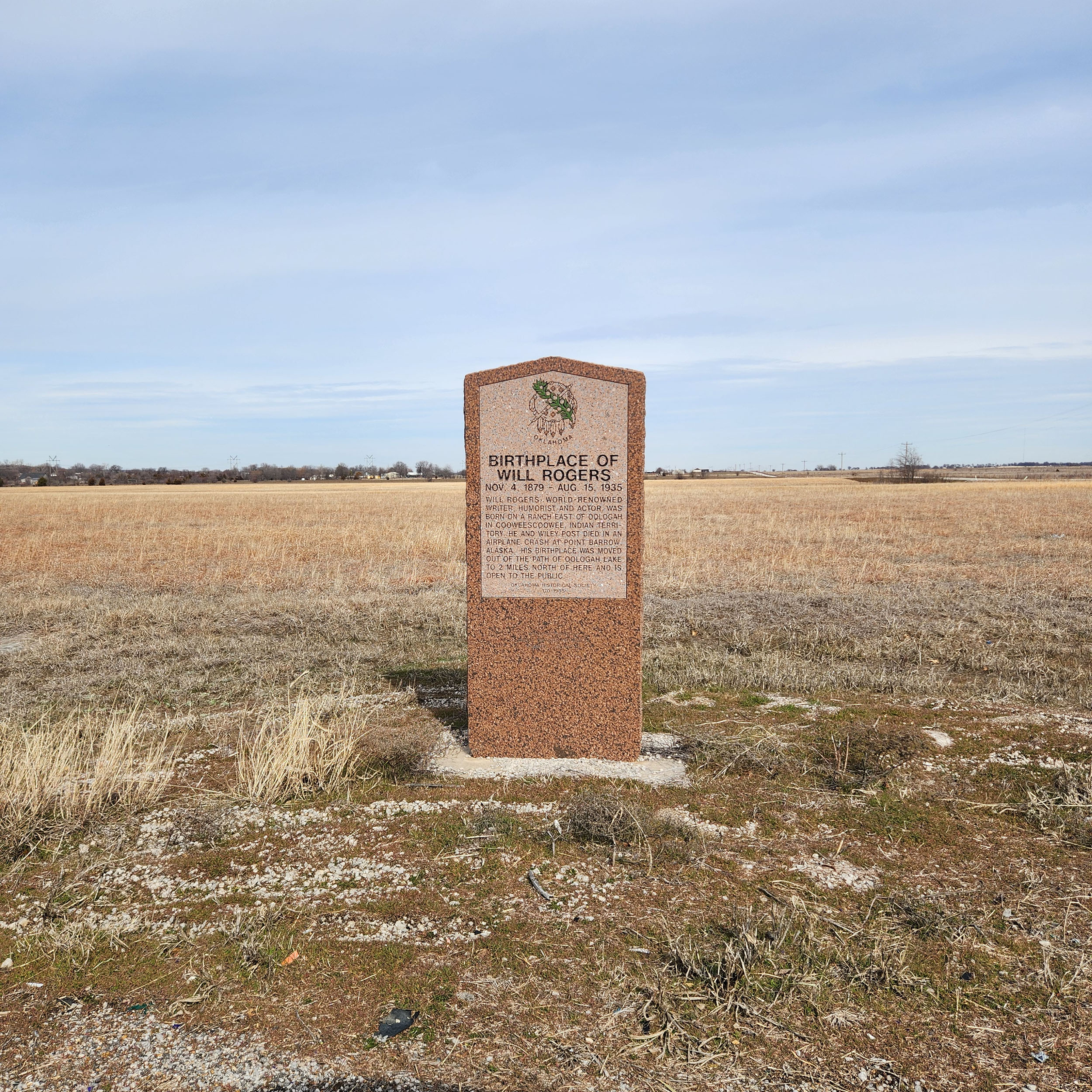
Birthplace of Will Rogers
Rogers CountyLocation: approximately one mile east of Oologah on OK-88
Coordinates: 36.437944, -95.68725
Material: Granite
Sponsor(s): Oklahoma Historical Society
Topics: American Indians; Arts; Early Statehood, 1907–1941; Mass Communication
World-renowned writer, humorist, and actor Will Rogers was born on a ranch east of Oologah in Cooweescoowee, Indian Territory, on November 4, 1879. He and Wiley Post died in an airplane crash at Point Barrow, Alaska, on August 15, 1935. His birthplace was moved out of the path of Oologah Lake to a site two miles north of here and is open to the public.
View image

View image
Birthplace of Will Rogers Replica
Rogers CountyLocation: on US-169 in Oologah
Coordinates: 36.446927, -95.708136
Material: Other
Sponsor(s): City of Oologah
Topics: American Indians; Arts; Early Statehood, 1907–1941; Mass Communication
Zennie Taylor constructed a replica of the Will Rogers birthplace in 1930. It was dedicated during a “Will Rogers Day” celebration in Oologah. The city of Oologah constructed a stone monument in memory of Will Rogers after his death in 1935. An arsonist destroyed the original replica of the house, which was replaced by a new model sponsored by the Oologah Chamber of Commerce.

View image

View image
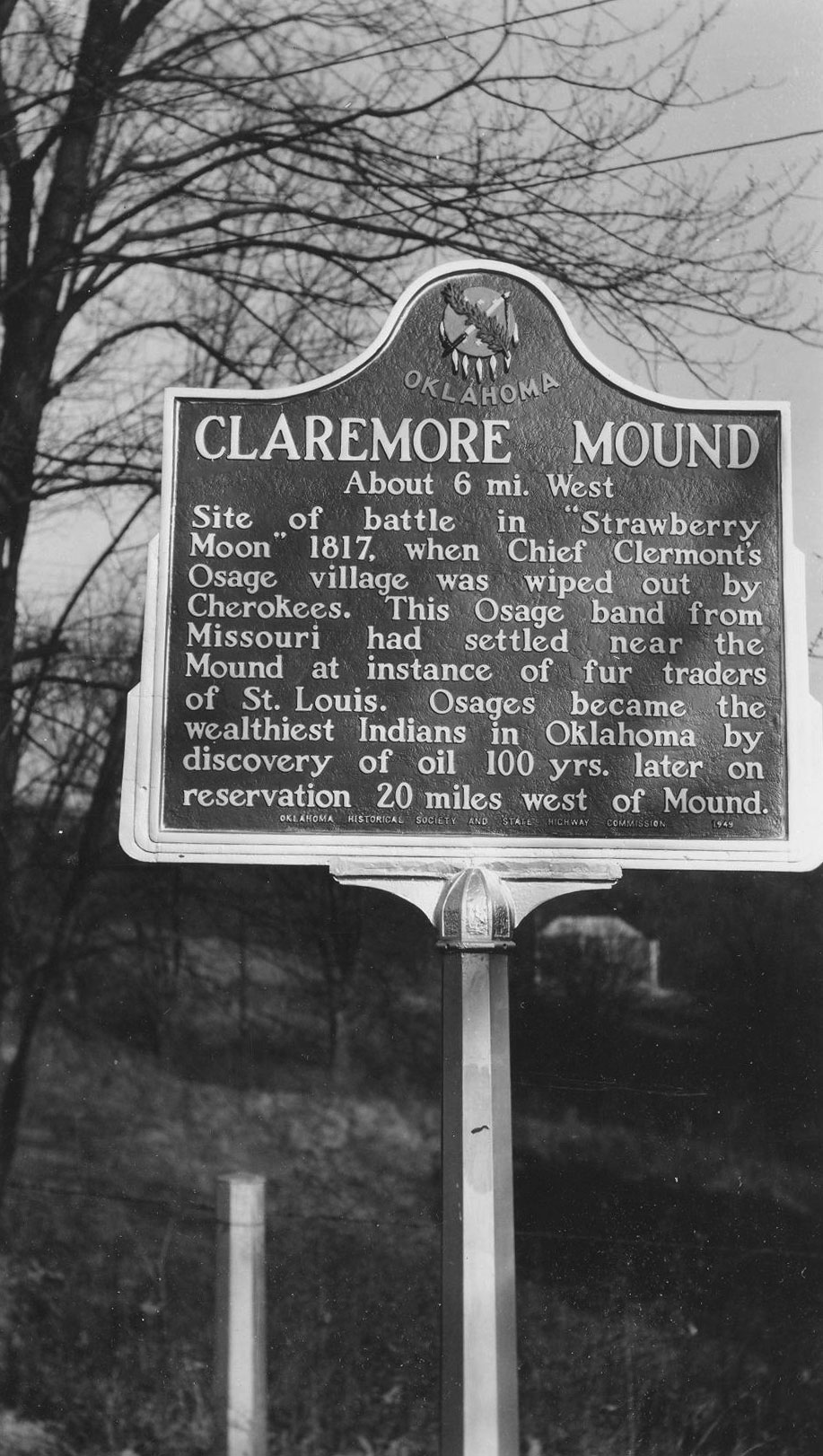
Claremore Mound
Rogers CountyLocation: approximately four miles north of Claremore on OK-88
Coordinates: 36.381983, -95.632867
Material: Granite
Sponsor(s): Oklahoma Historical Society
Topics: American Indians; Natural Resources; Westward Expansion, 1803–1861
Named for Osage Chief Clermont, this area was the site of an Osage village destroyed by the Cherokees in 1817. The Osage had settled in the area under the insistence of fur traders from St. Louis. One hundred years later, oil was discovered west of Claremore Mound on the Osage Reservation.
View image

View image
Clement Vann Rogers
Rogers CountyLocation: on the grounds of the Will Rogers Birthplace Ranch, Oologah vicinity
Coordinates: 36.467200, -95.665550
Material: Granite
Sponsor(s): Oklahoma Centennial Commission
Topics: American Indians; Government; Territorial Period, 1861–1907
Born in the Going Snake District, Cherokee Nation, Clement (Clem) Vann Rogers was the only son of Sallie Vann and Robert Rogers Jr. He was educated in the Cherokee Nation. He married Mary America Schrimsher and served in the Cherokee Confederate Cavalry. Clem and Mary eventually established a 60,000-acre ranch in the Cooweescoowee District. In 1870 they built their log-walled white house on the Verdigris River, where Will Rogers was born in 1879. Clem served on the bench in the Cherokee Senate and at the Oklahoma Constitutional Convention. After Mary’s death in 1890, Clem moved to Claremore where he was active in politics, banking, and business. He is buried in Chelsea. Rogers County was named in his honor.
Eastern University Preparatory School
Rogers CountyLocation: near south entrance of Claremont Elementary School, 318 East 7th Street, in Claremore
Coordinates: 36.312696, -95.604957
Material: Aluminum
Sponsor(s): Rogers State University
Topics: Early Statehood, 1907–1941; Education
Eastern University Preparatory School, the predecessor of Rogers State University (RSU), was founded in 1909 at this location, the former site of Claremore School. The original Claremont School was demolished in 1938 and a new Claremont Elementary School was later built on this site. RSU is now a major regional university and is located on College Hill on the west side of Claremore.

View image
Oklahoma’s First Waterflood
Rogers CountyLocation: approximately eight miles south of Nowata on US-169
Coordinates: 36.583512, -95.670700
Material: Granite
Sponsor(s): Oklahoma Historical Society and the Oklahoma Petroleum Council
Topics: Early Statehood, 1907–1941; Petroleum; Water
In May 1931, Bert Collins first used the injection of water into an oil reservoir in the attempt to increase oil recovery, a process that became known as waterflooding. Water is injected under high pressure into oil-bearing formations to force oil to nearby producing wells. An average of ten barrels of water is injected for each barrel of crude oil recovered. Billions of barrels of crude oil have been recovered from world oil reserves by water flooding.

View image
Old Mail Route
Rogers CountyLocation: on the grounds of Blue Whale of Catoosa Park on OK-66, Catoosa vicinity
Coordinates: 36.193683, -95.732683
Material: Aluminum
Sponsor(s): Mr. and Mrs. Carl R. Mathews
Topics: Mass Communication; Territorial Period, 1861–1907
This marker commemorates a mail relay station on the stage road between Vinita and Tulsa known as Fort Spunky. A post office was at this station from 1880 until 1883, when the Catoosa post office was designated with John Schrimsher as postmaster.

View image
Port of the Plains
Rogers CountyLocation: approximately two miles north of Catoosa on the grounds of Rogers Point Park
Coordinates: 36.211544, -95.721841
Material: Other (Stone with bronze plaque)
Sponsor(s): Port of Tulsa Propeller Club
Topics: Industrial Period, 1941–1982; Transportation; Water
Head of navigation for the McClellan-Kerr Arkansas River Navigation System, the Tulsa Port of Catoosa is located one mile upstream from this marker. The McClellan-Kerr Arkansas River Navigation System is a 448-mile channel stretching from the Mississippi River up the Arkansas and Verdigris Rivers to the Tulsa Port of Catoosa. Barges are raised a total of 420 feet via 17 locks and dams from the Mississippi to Catoosa, and the entire waterway connects with much of the nation’s 29,000 miles of inland waterways.
Note: This marker could not be located.
Pryor Creek Bridge
Rogers CountyLocation: northeast of Chelsea on OK-66
Coordinates: 36.538600, -95.414700
Material: Granite
Sponsor(s): Chelsea Area Historical Society
Topics: Early Statehood, 1907–1941; Transportation
The Pryor Creek Bridge was built in 1926 and carried traffic on US-66 from 1926 to 1932, when a new alignment of Route 66 bypassed the bridge. The bridge is 123 feet in length with a total width of 19 feet. It is the only remaining unaltered example of a modified Pratt through truss bridge in Oklahoma.
Will Rogers
Rogers CountyLocation: on grounds of the Will Rogers Memorial Museum in Claremore
Coordinates: 36.320893, -95.631981
Material: Other (Stone with bronze plaque)
Sponsor(s): Daughters of the American Revolution
Topics: American Indians; Arts; Early Statehood, 1907–1941; Mass Communication
The Oklahoma Society Daughters of the American Revolution have record of two historical markers placed on the grounds of the Will Rogers Memorial Museum. One is a bronze plaque set in stone (no date or chapter noted). The other is a bronze plaque set in stone dedicated on November 4, 1938, with wording that reads, “Honoring the memory of Will Rogers, Who kindly wit and homely Philosophy endeared him to the Whole World.”

View image
Will Rogers Highway
Rogers CountyLocation: on the grounds of JM Davis Arms & Historical Museum in Claremore
Coordinates: 36.314700, -95.614950
Material: Granite
Sponsor(s): City of Claremore
Topics: Early Statehood, 1907–1941; Transportation
US Highway 66 opened on November 11, 1926. It was nicknamed the Will Rogers Highway in honor of writer, humorist, and actor Will Rogers, who was born on a ranch north of Claremore.
(Page 1 of 1)
Marker Search
Use quotation marks to search for an exact phrase.
Browse by County
Adair County
Alfalfa County
Atoka County
Beaver County
Beckham County
Blaine County
Bryan County
Caddo County
Canadian County
Carter County
Cherokee County
Choctaw County
Cimarron County
Cleveland County
Comanche County
Cotton County
Craig County
Creek County
Custer County
Delaware County
Dewey County
Ellis County
Garfield County
Garvin County
Grady County
Grant County
Greer County
Harmon County
Harper County
Haskell County
Hughes County
Jackson County
Jefferson County
Johnston County
Kay County
Kingfisher County
Kiowa County
Latimer County
Le Flore County
Lincoln County
Logan County
Love County
Major County
Marshall County
Mayes County
McClain County
McCurtain County
McIntosh County
Murray County
Muskogee County
Noble County
Nowata County
Okfuskee County
Oklahoma County
Okmulgee County
Osage County
Ottawa County
Pawnee County
Payne County
Pittsburg County
Pontotoc County
Pottawatomie County
Pushmataha County
Roger Mills County
Rogers County
Seminole County
Sequoyah County
Stephens County
Texas County
Tillman County
Tulsa County
Wagoner County
Washington County
Washita County
Woods County
Woodward County
To find out more about the Oklahoma Historical Society Historical Marker Program or how to submit an application, please visit the Historical Marker Program page.
Missing or Damaged Markers
Please use our online form to report missing or damaged historical markers.
Report Missing or Damaged Markers
Contact Us
If you have questions, please contact:
Matthew Pearce
Oklahoma Historical Society
800 Nazih Zuhdi Drive
Oklahoma City, OK 73105
405-522-8659
[email protected]